
How to Calculate Car Flipping Profit Before You Buy (With a Simple Formula)
Learn how to calculate car flipping profit before you buy. A simple formula, the hidden costs most flippers miss, and a checklist for a walk-away number.
Most first-time flippers judge a deal with one number: the gap between the asking price and what similar cars sell for. That gap is not your profit. It’s the starting point. (If you’re still working out whether a car is underpriced at all, start with how to tell if a used car is a good deal.)
Between buying and selling, money leaks out in a dozen small places. Learn to plug those leaks on paper first, and you’ll avoid the cars that look cheap and end up costing you.
This guide gives you a formula, a worked example, and a short checklist you can run in five minutes on any listing.
The Car Flipping Profit Formula
Here it is:
Profit = Sale price − Purchase price − Recon − Fees and taxes − Holding costs
Each piece is an estimate until the car sells, so build in a cushion. Let’s go through them one at a time.
1. Sale price: use sold prices, not asking prices
Asking prices are wishes. Sold prices are facts.
- Check recently sold listings, not active ones. Active listings that sit for 60 days tell you the price is too high.
- Match trim, mileage (within about 10,000 miles), title status, and region.
- Use the low-middle of the range, not the top. If comps sold between $9,000 and $10,500, plan around $9,500.
2. Purchase price: include what you actually pay
The number in the listing isn’t always the number leaving your account. Add:
- Travel costs to see the car (fuel, time, a second trip to pick it up)
- A pre-purchase inspection or a diagnostic scan
- Towing, if it doesn’t run
3. Recon: the number that sinks most flips
Reconditioning is everything you do to make the car sell: repairs, tires, detailing, paint touch-ups, fixing warning lights.
Professional dealers treat this seriously because it eats margin. Industry data shows used vehicle gross profit averaged about $1,409 per unit in Q2 2026, and after expenses, net margins commonly land in the 1–3% range. Dealers have scale, floorplan financing, and wholesale access, and they still live on thin spreads. As an individual flipper, you can’t afford to guess on recon.
Practical ways to estimate it:
- Get a quote for any known problem before you buy, not after.
- Price tires at 100% of replacement cost if tread is under 5/32”.
- Add $150–$300 for a proper detail. Clean cars sell faster and for more.
- Add a 15% buffer to your total recon estimate for surprises.
4. Fees and taxes
These vary by state, so check your local rules. Typical items:
- Title transfer and registration fees
- Sales tax, where it applies to your transactions
- Dealer licensing requirements if you flip beyond your state’s limit on private sales
- Payment processing or listing fees
If you flip more than a few cars a year, many states expect you to be licensed. Check with your DMV before your third or fourth flip, not after. Our guide to car flipping laws by state covers the limits.
5. Holding costs
Every day the car sits, it costs you. People forget this one more than any other.
- Insurance while you own it
- Storage or parking, if you don’t have a driveway
- Financing interest, if you borrowed to buy
- Opportunity cost: money tied up in a car can’t buy the next one
A good rule: assume $5–$15 a day in holding costs, then multiply by your realistic days-to-sell. If similar cars take 30 days, that’s $150–$450.
A Worked Example
Say you find a 2014 sedan listed at $6,800. Sold comps put it around $9,500.
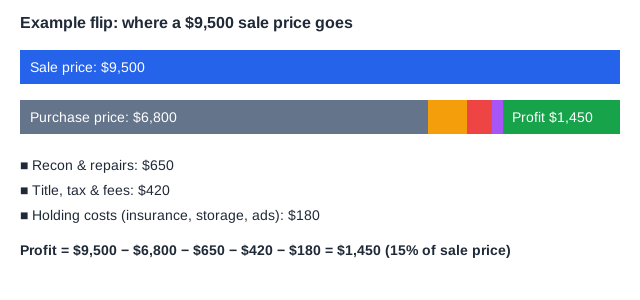
| Line item | Amount |
|---|---|
| Expected sale price | $9,500 |
| Purchase price | −$6,800 |
| Recon (tires, brakes, detail, buffer) | −$650 |
| Title, tax, and fees | −$420 |
| Holding costs (about 18 days) | −$180 |
| Estimated profit | $1,450 |
That’s a healthy 15% of the sale price. But watch what happens if recon runs $600 over and the car takes 45 days to sell instead of 18:
- Extra recon: −$600
- Extra holding: −$270 or so
- New profit: roughly $580
Same car, same purchase price, profit cut by more than half. That’s why you stress-test every deal.
Find Your Walk-Away Number
Don’t decide a deal is good after seeing the car. Decide your maximum purchase price in advance.
Work backwards:
- Start with your realistic sale price.
- Subtract your target profit (many flippers aim for at least $1,000 or 10–15% per car).
- Subtract estimated recon, fees, and holding costs.
- What’s left is the most you should pay.
In our example, with a $1,000 profit target, the walk-away price is $9,500 − $1,000 − $650 − $420 − $180 = $7,250. If the seller won’t go below $7,500, you walk. Simple as that.
Write this number down before you message the seller. It protects you from the emotional pull of a nice-looking car.
Red Flags That Break Your Math
Some warning signs mean the numbers you’ve built can’t be trusted:
- Price far below market. Scammers lure buyers with prices well under market value and ask for money up front. Never pay before you’ve inspected the car in person.
- Title problems. Salvage, rebuilt, or missing titles change your sale price dramatically, and some buyers won’t touch them.
- “Needs just a little work.” Ask what, specifically. Vague answers usually mean expensive ones.
- Seller refuses an inspection. Walk away.
- Only one key. A second key can cost a couple hundred dollars to replace on newer cars.
A Five-Minute Pre-Buy Checklist
Before you offer on any car, run through this:
- Found at least 3 sold comps with similar trim and mileage
- Used the low-middle price, not the best case
- Got or estimated repair costs for every known issue
- Added a 15% recon buffer
- Included title, tax, and registration costs
- Estimated days to sell and daily holding cost
- Calculated a walk-away price and wrote it down
- Confirmed the title is clean and in the seller’s name
If you can’t tick every box, you’re not evaluating a deal yet. You’re guessing.
Make It a Habit
Flipping profitably isn’t about finding one amazing deal. It’s about running the same simple math on every car and passing on the ones that don’t clear your bar. Do that consistently and the wins add up while the costly mistakes never happen.
Start with a spreadsheet using the five line items above. For the rest of the process, from sourcing to selling, see how to flip cars for profit. After five or ten flips, you’ll have your own data on recon and days-to-sell, and your estimates will get sharper every time.
Profit figures in this article are illustrative. Costs, taxes, and licensing rules vary by location, so confirm local requirements before you buy and sell vehicles.

