Best App for Finding Cars: 10 Tools Compared for 2026
Looking for the best app for finding cars? Compare 10 options on marketplace coverage, price context, alerts, and resale tracking for buyers and dealers.

A clean, well-priced car lands on Facebook Marketplace at 9:14 on a Tuesday morning. By 9:40 it has three messages. By lunch the seller has marked it pending, and the next person to open the app sees nothing but a gray banner.
That’s the whole game. You rarely lose these cars because you picked the wrong filters. You lose them because you were eleven minutes late.
Most roundups rank search apps by inventory count. Inventory count tells you almost nothing about whether you’ll see the right car in time. I judge every tool here on four jobs instead:
- Marketplace coverage. Does it watch the places where the car appears, including private sellers and classifieds?
- Saved-search alerts. Can it hold your criteria between visits and tell you when something new matches?
- Price context. Does it help you decide whether the asking price is sane?
- Resale tracking. If you buy to sell, does it keep costs and proceeds in one place?
No app does all four well. Some are research libraries, some are dealer inventory sites, and a few are genuine monitoring tools. That distinction matters more than any inventory claim, and it’s why the best app for finding cars depends entirely on how you search.
The volume explains the urgency. Cox Automotive counted approximately 37.4 million used-vehicle sales in 2024, including 19.9 million retail transactions (Cox Automotive used-vehicle sales analysis). A lot of cars change hands. The desirable ones change hands in hours.
Every app below gets the same treatment: what it’s for, what it does well, and where it stops. Price estimates in any of these tools are guides, not guaranteed valuations.
1. Flipify Motors
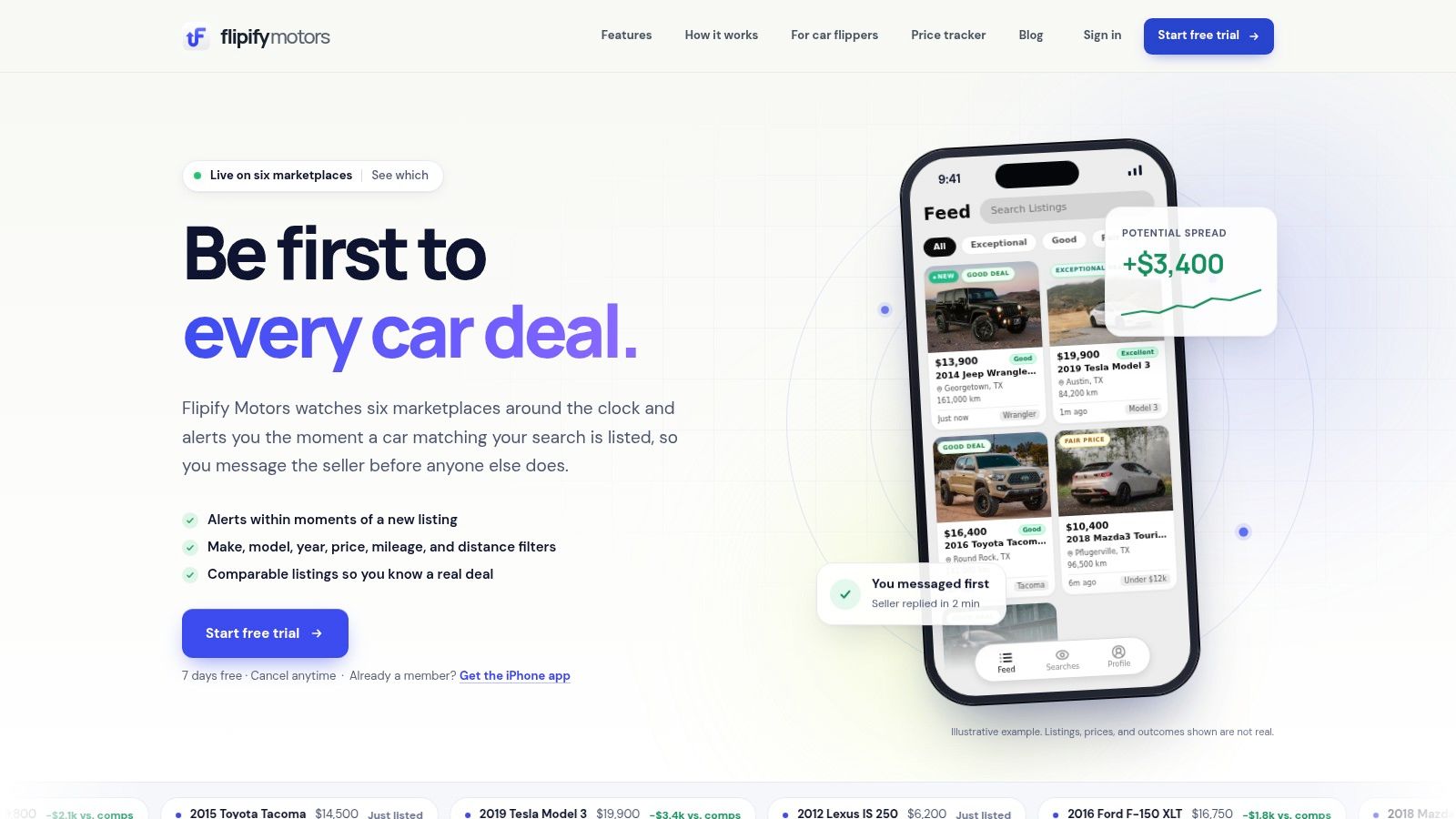
Flipify Motors is built around monitoring rather than browsing. It scans new listings continuously and filters out the noise, so the matches that reach you are the ones that fit your criteria.
Watchlists replace repeat searching
You describe the car once: make, model, year, price ceiling, mileage cap, transmission, and how far you’re willing to drive. Flipify Motors holds that as a watchlist and monitors six marketplaces at the same time, covering Facebook Marketplace, AutoTrader.ca, AutoTrader.com, Craigslist, OfferUp, and eBay Motors. You choose which sources each search includes, and new matches arrive in one feed instead of six browser tabs.
The alerts are what change behavior. Notifications go out within moments of a matching listing being posted. A push notification carries the price, mileage, and distance, and one tap opens the original listing so you can message the seller directly. On a car that will be gone by lunch, that gap is the whole product.
Price context and flip records together
Comparable listings show what similar cars are asking, and deal scores appear where the data supports them. A separate price tracker summarizes typical asking prices for used models, drawn from real listings across the same marketplaces. On the resale side, inventory tools record purchase cost, listing status, sale price, and estimated profit, which is the part most search apps skip entirely.
Practical rule: treat a deal score as a prompt to check comparables, not as a verdict. It flags a listing worth a phone call.
What works
- One alert feed, six sources. Facebook Marketplace, AutoTrader.ca, AutoTrader.com, Craigslist, OfferUp, and eBay Motors feed a shared workflow rather than six separate searches.
- Granular watchlist filters. Make, model, year, price, mileage, transmission, and distance keep narrow searches narrow.
- Price context beside the listing. Comparable listings, available deal scores, and model-level asking-price ranges sit in the same view.
- Resale tracking built in. Purchase costs, sale status, and estimated profit stay attached to the car from acquisition to sale.
Where it falls short
- Subscription pricing isn’t published on the site, so confirm the cost after the seven-day free trial before you commit.
- Listings belong to third-party marketplaces. A match can be sold, stale, or badly described. The alert tells you it’s new, not that it’s still available.
- Comparable figures are context, not appraisals. Deal scores appear only where the data supports them, so a match without one still needs a manual comp check before you drive out.
It runs as a website, a web app at app.flipifymotors.com, and mobile apps. Website: flipifymotors.com
2. AutoTempest
AutoTempest earns its place for one job: running the same search across several large listing sites so you don’t retype filters six times.
It pulls from Cars.com, TrueCar, eBay Motors, Carvana, Hemmings, and Cars & Bids. Mainstream inventory and enthusiast inventory in one place is a real advantage when you want a specific trim or a car that’s rare in your region.
Where the coverage stops
The catch is arithmetic. Not every source’s listings appear directly in results. Some sites open through comparison links, which means you’re clicking out and re-filtering there anyway. It doesn’t provide a complete feed of every marketplace or private listing, and the Facebook Marketplace and Craigslist traffic that produces most cheap cars isn’t the point of the tool.
Multi-site browsing is the default anyway. In the 2025 Cox Automotive Car Buyer Journey Study, 75% of buyers used third-party automotive websites, rising to 77% of used-car buyers, and shoppers visited an average of 4.6 vehicle-shopping sites, or 4.8 when shopping used. Checking several sources isn’t obsessive. It’s what everyone does.
For a walkthrough on consolidating those sources, see searching all marketplaces at once.
AutoTempest is a search launcher, not a sentry. It won’t tap you on the shoulder when the right car appears.
- Strengths: fewer repeated searches, nationwide reach, and enthusiast sources sitting beside mainstream ones.
- Weaknesses: partial direct coverage, saved-search and cross-device features that are thinner than big marketplaces offer, and no consolidated private-party classifieds feed.
Website: AutoTempest
3. CarGurus
Say you find a 2019 RAV4 at a dealer 40 minutes away and the price looks $1,500 low. CarGurus is built to answer the next question: is that discount real, or is the car overpriced against a market that’s already soft?
Deal ratings and market-value comparisons sit directly on eligible listings. You also get price-change history, time-on-lot details, and dealer ratings. That combination does more for negotiation than a spec sheet, because it shows whether a car has been sitting while others sell.
What the ratings don’t tell you
A great-deal badge compares an asking price to other asking prices in that market. It knows nothing about missed service intervals, repaired panels, or worn tires. It’s also primarily a dealer-listing marketplace, so local private-party inventory can be thin, and the tool is far more focused on comparing listed cars than on tracking resale costs or profit.
Digital preference keeps rising, which is why shopping tools now shape the whole process. A 2025 CarGurus survey of 3,030 recent buyers and sellers found 83% of consumers preferred completing more car-shopping steps from home, up from 72% in 2022.
If you’re using those ratings to negotiate, pair them with a method for telling whether a used car is a good deal before you drive out.
Who it fits: private buyers comparing dealer inventory, and anyone who wants a second opinion on an asking price. Who it doesn’t: flippers tracking a dozen cars through purchase, reconditioning, and sale, since there’s no inventory ledger here.
Website: CarGurus
4. Cars.com
Used-car buyers spend far longer researching than they do standing in a dealership. The 2024 Cox Automotive Car Buyer Journey Study put it at 7 hours and 29 minutes online against 2 hours and 54 minutes with the dealership or seller, based on more than 2,300 buyers. The same research found buyers who completed online steps such as credit applications or pre-filled paperwork saved an average of 40 minutes at the dealership.
Cars.com is the app for that research block. You get new, used, and certified listings in one search, saved vehicles, price-drop alerts, monthly payment estimates, and value tracking. Carson Vision lets you identify a vehicle from a photo, which is useful when you’re standing in a parking lot trying to work out what trim you’re looking at.
The honest limits
Cars.com is a listing and research service, not the seller. It doesn’t search every classifieds site and marketplace in one place, so a car posted only on Facebook Marketplace won’t appear. Listing accuracy and completeness vary by seller, and a dealer-written description is marketing copy, not a disclosure document.
- Best use: a first broad sweep of dealer inventory in your budget, with saved searches to catch price drops.
- Skip it for: instant notification on private-party bargains, and any kind of purchase-to-sale tracking.
- Free tier: basic browsing works without an account, and signing in syncs saved cars between the app and website.
Website: Cars.com
5. iSeeCars
Precision filters for picky buyers
iSeeCars is the tool for someone who knows exactly what they want and refuses to compromise. Its filters go deep on vehicle attributes and features, which is the difference between “SUV under $20,000” and “three rows, second-row captain’s chairs, adaptive cruise, tow package, under 60,000 miles.” If you are hunting one specific trim, it gets you there faster than broad keyword searches.
On top of the filtering, it provides market-value estimates, deal rankings, dealer ratings, and sorting by price or deal quality. Those estimates are guidance, not guaranteed valuations, and they’re only as good as the listings in your area. Search usefulness drops sharply in rural markets with thin inventory.
The research-first habit is mainstream now. CarGurus’ 2024 Consumer Insights study reported 90% of U.S. buyers researched vehicles online in 2024, up from 81% in 2023. That shift rewards tools with detailed filtering over a basic classifieds search.
Watch the paid add-ons
Some separate services are paid, including higher-volume VIN reporting plans. Budget for that if you’re screening several cars a week rather than one.
Keep the estimate in perspective too. A market-value number can’t see a prior repair, a salvage title that was never reported, or a seller with an unrealistic price.
- Strong fit: enthusiasts hunting a specific configuration, and buyers willing to travel for the right car.
- Weak fit: dealers who need alerts the moment a listing goes live across multiple marketplaces.
Website: iSeeCars
6. Autotrader
Autotrader is the broad marketplace already familiar to shoppers, and the reason to keep it is inventory depth rather than cleverness. New, used, and certified pre-owned listings sit together, with saved searches, favorite listings, and alerts for price drops and new matching inventory. Many listings include Kelley Blue Book Price Advisor information.
The saved-search alerts matter more than the browsing. They let you follow a model and trim over weeks and watch asking prices drift down as cars sit.
The alert timing problem
Here’s where Autotrader costs private buyers money. Saved-search alerts may arrive daily or weekly rather than immediately, and by the time a notification lands the car is often sold. The tool also doesn’t consolidate every major marketplace into one feed, so a car cross-posted to Craigslist or OfferUp may never show up.
Shoppers are also cross-shopping more than they used to. The Cox Automotive 2025 Car Buyer Journey findings show 66% of buyers considered both new and used vehicles, up from 57% previously, while only 7% completed the entire purchase online and 53% completed all steps at a dealership. A marketplace that mixes new and used inventory suits that indecision, and the completion numbers explain why alerts should funnel you toward a phone call, not a checkout.
- Use it for: building a shortlist of dealer listings and tracking price movement over a few weeks.
- Don’t rely on it for: speed. If the car will sell within an hour of posting, a daily digest won’t save you.
Website: Autotrader
7. CARFAX
Finding a car and validating a car are two different jobs. Most apps only do the first.
CARFAX is the second job, at least partially. Its used-vehicle listings include a CARFAX Report alongside the ad, so you can screen accident history, service records, and title events before you ever message a seller. You also get alerts for new listings, price drops, and vehicles marked sold, plus saved favorites and dealer ratings. Listings and app searches are free to access.
The scope is narrow by design. It’s less focused on searching multiple marketplaces than AutoTempest, and reports only reflect records available to CARFAX. A clean report is not proof of a clean car.
Why this matters more than speed
Buyers still want eyes on the car. A CarGurus study of AI and omnichannel shopping found 86% of consumers still prefer seeing a vehicle in person, especially for a test drive, price negotiation, and judging reliability, even while most want to handle more of the process from home. That gap is the main problem with every app on this list: digital search doesn’t remove physical verification, it just decides which listings deserve your inspection time.
If you’re flipping, report quality changes your margin math. That’s why it’s worth comparing CARFAX against AutoCheck for flippers before you build a screening process around one of them.
- Best use: screening candidates before you call, and flagging title or accident issues early.
- Weakness: not a cross-marketplace monitor, and not a substitute for an independent inspection.
Website: CARFAX
8. Edmunds
Edmunds answers the question that comes before “which one should I buy”: what is this thing really going to cost me over three years?
You get dealer inventory search alongside specifications, safety information, expert and owner reviews, True Market Value estimates, and estimated ownership costs. For a buyer deciding between a hybrid sedan and a compact SUV, that combination is more useful than a bigger listing feed.
Research tool first, marketplace second
The inventory is primarily dealer-focused, so private-party cars are largely out of scope. It isn’t designed to monitor multiple classifieds or manage resale inventory, and its price and ownership-cost figures are estimates rather than guaranteed transaction prices.
Market data explains why older, cheaper inventory deserves more attention than it usually gets. A CarGurus report on 2025 used-market demand found that approximately 73% of the year-over-year increase in used-vehicle sales came from vehicles priced below $30,000, with growth concentrated in vehicles seven years old or older. If you’re a flipper, that means the volume is in older cars with higher repair risk, and Edmunds is where you sanity-check a model’s reliability record and running costs before committing.
- Use it for: model selection, ownership-cost estimates, and pre-purchase research on a shortlist.
- Skip it for: spotting new listings fast, or tracking a flip from purchase to sale.
Website: Edmunds
9. eBay Motors
eBay Motors is where the enthusiast and the patient buyer go. It combines vehicle listings with parts and accessories, covers both everyday cars and specialty inventory, and lets you search by make, model, year, and other details with local filtering.
There’s a real advantage for project cars and oddball models here. Auction formats, fixed prices, and offers where available mean you can sometimes buy below market by being the only bidder with cash ready. Some listings include history reports, and many eligible purchases carry Vehicle Purchase Protection.
Mobile shopping is now normal, and auctions reward it. CarGurus’ 2025 consumer insights found 54% of surveyed consumers used their phones more than desktop computers for digital car shopping and selling, with 31% using both equally. Auction countdowns are exactly the kind of thing that needs a phone.
Where auctions bite
Everything about an auction transaction requires care. You may be bidding on a car you haven’t inspected, from a seller you can’t meet, with terms that vary per listing. Protections apply to eligible purchases, not all of them, so read each listing’s terms before you bid.
Never bid on a car you haven’t budgeted an inspection for. Set your walk-away number before the auction opens, not when there are 90 seconds left.
- Best use: rare models, project cars, and regional finds that never reach dealer sites.
- Weakness: no saved-search monitoring across other marketplaces, and remote purchase risk that’s on you.
- What to arrange yourself: inspection and transport, neither of which eBay handles.
Website: eBay Motors
10. CarMax
One seller, one process
CarMax sells its own used-vehicle inventory, and that’s the entire pitch. You search one retailer’s stock, save search criteria, get matching-inventory alerts, compare models and trims, estimate payments, and explore prequalification. One seller means one set of paperwork, one return policy to read, and one process from search to keys.
For a private buyer who wants to be done in a weekend, that consistency is worth real money. For anyone sourcing inventory to resell, it’s the opposite: CarMax’s retail pricing leaves no margin for a flipper.
What you give up
Search covers CarMax inventory, not competing dealers or private sellers, so it’s not a general marketplace or a cross-platform discovery tool. Selection and availability depend entirely on what’s sitting in inventory near you, and you won’t find the sub-$5,000 project car or the private-party bargain that funds a flip.
The used-only angle is broader than it looks. A Consumer Reports survey of 2,032 U.S. adults found 40% of adults who had been in the market for a vehicle were considering only used vehicles. For that group, a retailer with a standardized process and its own inventory is a reasonable default.
- Best use: private buyers who value process over price and want financing handled in one place.
- Weakness: zero resale utility, and no visibility into the private-party market where the deals are.
Website: CarMax
How the Leading Car-Search Apps Compare on Coverage, Alerts, Price Context, and Resale Tracking
Read the table as four separate jobs. Coverage asks where the listings come from. Alerts ask whether the app watches for you or waits for you to refresh. Price context asks whether you can tell a deal from an optimistic asking price. Resale tracking asks whether the app still matters after money changes hands.
| Item | Marketplaces covered | Saved searches and alerts | Price context | Resale tracking |
|---|---|---|---|---|
| Flipify Motors (recommended) | Facebook Marketplace, AutoTrader.ca, AutoTrader.com, Craigslist, OfferUp, and eBay Motors | Custom watchlists and push alerts with listing details and source links | Comparable listings, deal scores, and model-level asking-price ranges | Tracks purchase costs, sale status, proceeds, and estimated profit |
| AutoTempest | Aggregates listings from multiple sites, including Cars.com, TrueCar, eBay Motors, Carvana, Hemmings, and Cars & Bids | Saved-search features are limited | Multi-site listing comparison; no dedicated price estimates specified | No resale tracking; an aggregation tool only |
| CarGurus | Primarily dealer listings | Saved searches with email alerts for new matches and price drops | Deal ratings, Instant Market Value estimates, price changes, and time on lot | Not designed for resale tracking |
| Cars.com | Cars.com listings; does not search all marketplaces | Saves listings and searches; price-drop alerts | Payment estimates and vehicle value tracking | Limited to vehicle value tracking; no inventory or profit management specified |
| iSeeCars | Listings available through its search service | Saved searches with alerts tied to its deal ratings | Market-value estimates and deal rankings | No resale tracking; a search and analysis tool |
| Autotrader | Autotrader dealer and some private-seller listings | Saved searches and favorites; alerts for price drops and new matches | Kelley Blue Book Price Advisor information on listings | No purchase-to-sale tracking |
| CARFAX | CARFAX used-vehicle listings | Saved favorites; alerts for new listings, price drops, and sold vehicles | Vehicle-history reports; no price analysis specified | No resale tracking; history reports are the core product |
| Edmunds | Primarily local dealer inventory | Saved searches | True Market Value estimates and ownership-cost estimates | Not designed for resale tracking |
| eBay Motors | eBay vehicle listings, plus parts and accessories | Saved searches and watched items with email alerts | Fixed-price, auction, and offer listings | Sold listings work as comps; no profit tracking across a purchase and sale |
| CarMax | CarMax used-vehicle inventory only | Saved searches and matching-inventory alerts | Payment estimates and model or trim comparisons | Zero resale utility; a retail purchase channel |
The pattern holds row by row. Aggregators and marketplaces handle the first two jobs, research tools handle the third, and single-inventory retailers stop at the first. The empty cells are the story: every app here does some of the work, and exactly one row fills all four columns.
Choosing the Right App for Your Car Search
The right pick depends on what you’re doing with the car, not on which app has the largest inventory number. Three buyer types, three different answers.
Private buyers need speed above everything. Your problem is that the good car was posted 40 minutes ago, so prioritize tools that watch multiple marketplaces and notify you immediately rather than tools that email a digest. Set the watchlist narrow: one or two models, a hard price ceiling, a mileage cap, and a realistic driving radius. A wide search produces noise you’ll stop reading within a week.
Dealers sourcing inventory need price context and a repeatable review process. That means saved criteria for the segments you stock, comparable listings next to every candidate, and one queue where new matches get triaged each morning. The workflow question is whether a listing can be judged in 30 seconds without opening five tabs.
Flippers need all four jobs at once, which is why most single-purpose apps fail them. Alerts find the car, price tracking tells you whether the margin exists, and purchase-to-sale records tell you whether you made money after reconditioning, transport, and holding costs. A flip you can’t measure is a hobby.
Research apps complement this rather than replacing it. Edmunds is where you check ownership costs and known model faults. CARFAX or AutoCheck is where you screen title and accident history. Neither one watches listings for you, and neither one inspects the car. Alerts, research, and inspection solve three different problems in sequence.
The practical sequence I’d give anyone:
- Define criteria before installing anything. Make, model range, year floor, mileage ceiling, budget, and distance. Write it down.
- Test alerts on a narrow search for a week. If you’re getting 40 notifications a day, tighten the criteria until you’re getting three you’d call about.
- Verify every estimate against real comparables. Market-value badges and deal scores are built from asking prices, not sold prices. Check what similar cars sold for, and check what the local market is listing at today.
- Inspect before paying. Nothing in any app replaces a pre-purchase inspection on a lift, and no report replaces eyes on the frame, the paint, and the tires.
Flipify Motors offers a seven-day free trial that you can start from the website and cancel at any time, which is a low-risk way to test whether a multi-marketplace watchlist earns its place in your routine. Subscription pricing isn’t listed on the site, so confirm the cost before the trial converts. Run the trial on the narrow search from step one rather than a broad one, and you’ll know within a few days whether the alerts are beating your manual refreshing.
Most buyers lose the good cars to timing, not to bad judgment. Flipify Motors watches six marketplaces at once, including Facebook Marketplace, AutoTrader.ca, AutoTrader.com, Craigslist, OfferUp, and eBay Motors, and pushes a notification with the price, mileage, and distance as soon as a matching listing appears. Save a watchlist with your make, model, budget, mileage limit, transmission, and driving radius, and the new matches arrive in one feed with comparable listings beside them. Start the seven-day free trial and see whether the right cars reach you before they reach the next buyer at Flipify Motors.