Carfax vs. AutoCheck for Car Flippers: Which Vehicle History Report Is Worth Paying For?
Carfax vs. AutoCheck for car flippers: what each report covers, what it costs, and a three-stage VIN-check routine that keeps history-report spending low.

If you flip one car a year, paying for a Carfax report is no big deal. If you look at 30 cars a month, report fees become a real line item on your profit sheet.
That’s the question most “Carfax vs. AutoCheck” articles skip. They’re written for someone buying one family car. A flipper needs something different: the cheapest way to avoid a bad buy, across a lot of leads.
This guide compares the two big reports, adds the government-backed option most buyers forget, and gives you a routine that spends money only where it matters.
The short answer
- Carfax is usually the better pick for service and maintenance history on a car you’re about to buy.
- AutoCheck is usually the better pick for cars that may have passed through auctions, and it’s generally cheaper, especially in multi-report packs.
- An NMVTIS report is the cheapest way to check title brands, total-loss history, and odometer data.
- None of them replaces an inspection. More on that below.
Carfax vs. AutoCheck: what’s actually different
Both reports pull from DMV records, insurers, and other data partners, and both can show reported accidents, title problems, and odometer readings. The differences are at the edges, and the edges are where flippers make money.
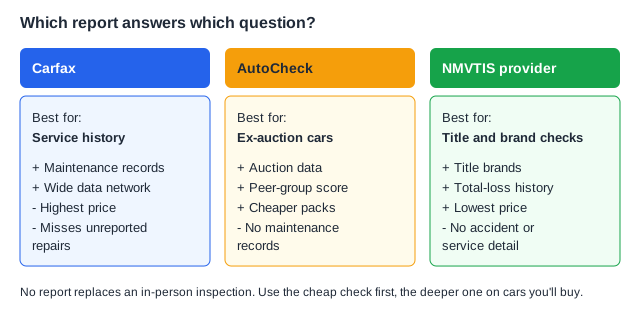
| Carfax | AutoCheck | NMVTIS provider | |
|---|---|---|---|
| Best for | Service history | Ex-auction cars | Title and brand checks |
| Maintenance records | Yes | No | No |
| Auction data | Limited | Strong | No |
| Comparison score | No | Yes, versus similar cars | No |
| Typical cost | Highest | Lower, with multi-report packs | Lowest |
Comparisons from Credit Karma and Capital One line up on the main points. Carfax includes maintenance records, while AutoCheck doesn’t. AutoCheck adds a numerical score that compares a car against peers of similar age and mileage, and it’s better at tracking cars that went through auctions. Carfax is generally the pricier of the two.
Prices change often, so check each site before you buy a pack.
Why auction data matters to flippers
Plenty of the cars you’ll flip are ex-dealer trades, ex-fleet, or ex-auction. A car that’s been through two auctions and three owners in 18 months deserves a harder look than one with a single owner and dealer service records. AutoCheck’s auction coverage can surface that pattern.
Service records matter for a different reason. A documented oil-change history is a selling point you can pass to your buyer. If you plan to list a car with its records, a Carfax service history helps you write a better listing. Our guide to writing a used car listing that sells fast covers how to use that proof.
The third option: an NMVTIS report
The National Motor Vehicle Title Information System (NMVTIS) is run by the U.S. Department of Justice. It focuses on the facts that cost flippers the most money: current title state, brand history (like salvage, flood, or rebuilt), total-loss history, and the latest reported odometer reading. You get it through approved providers.
It won’t tell you about a fender-bender that never touched insurance. But if your first question is “is this title clean?”, it’s the cheapest way to answer it. That’s the same question behind our guide to flipping rebuilt title cars, where a hidden brand can wreck your margin.
Why a clean report doesn’t mean a clean car
Reports only show what someone reported. The FTC’s used car advice says a vehicle history report isn’t a substitute for an independent inspection. Small wrecks repaired out of pocket, or work done at shops that don’t report, never make it onto the page. Open safety recalls are another gap worth closing, and the free fix is in our guide to checking a used car for open recalls.
Odometer fraud is the clearest example of why reports aren’t a safety net. Carfax data reported by Digital Dealer suggests roughly 2.45 million cars on U.S. roads are suspected of having rolled-back odometers, a 14% jump from the year before. Affected vehicles lost an average of about $3,300 in value.
For a flipper, that’s the whole margin on a typical deal and then some. If a rolled-back car slips through, you may be the one who sells it, which creates a legal problem on top of a financial one. A mileage reading that doesn’t match wear on the pedals, seat, and steering wheel is a reason to walk away, whatever the report says.
A three-stage routine that keeps costs down
Don’t run a paid report on every lead. Most leads die long before a report would matter. Spend in stages instead.
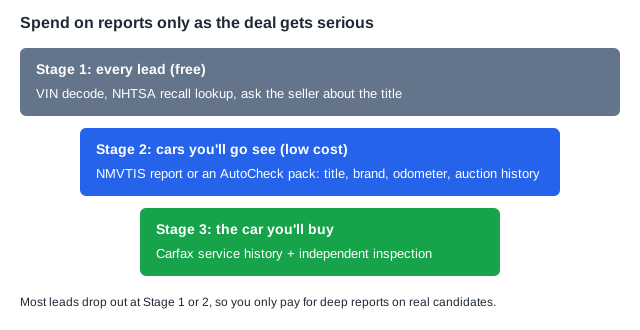
Stage 1: free checks on every lead
Before you message the seller, do the free work:
- Ask for the VIN and confirm it decodes to the right year, make, and trim.
- Look up open recalls on NHTSA’s recall lookup.
- Ask directly: “Is the title clean, and is it in your name?”
- Compare the price to the market using the steps in our guide to telling if a used car is a good deal.
If the price only works with a perfect history, don’t pay for a report until you’ve seen the car.
Stage 2: a low-cost report on cars you’ll go see
Once you’re driving out to look at a car, run an NMVTIS report or an AutoCheck from a multi-report pack. You’re checking for dealbreakers: title brands, a total loss, odometer inconsistencies, or a suspicious number of auction sales.
If you’re buying regularly, an AutoCheck pack usually beats paying per report. It’s the same math as any bulk purchase.
Stage 3: Carfax and an inspection on the car you’ll buy
When you’re ready to make an offer, spend on the deep check. A Carfax report can add service history and reported-accident detail. Pair it with a pre-purchase inspection by an independent mechanic. The inspection finds what the report can’t, and it gives you a price-negotiation tool.
Use what you find to update your numbers. A reported accident or a pending repair changes your budget, and our guide on calculating car flipping profit shows how to rework your walk-away number.
Quick rules of thumb
- Buying ex-auction or fleet cars? Lean on AutoCheck.
- Want records to show your future buyer? Add Carfax once you’ve decided to buy.
- Just checking for title problems? Start with NMVTIS.
- Report is clean but the car feels off? Trust your inspection.
- Seller refuses to share the VIN? Walk away.
Frequently asked questions
Is Carfax or AutoCheck more accurate?
Neither is consistently more accurate. They draw on overlapping but different data sources, so each can miss things the other catches. Carfax tends to have richer service records, and AutoCheck tends to have better auction coverage.
Do dealers use Carfax or AutoCheck?
Both. Many dealers use whichever they get a better rate on, or run both on cars they plan to retail. As a small flipper, you can mirror that: use the cheaper report to screen and the other for a final check.
Can I check a VIN for free?
You can decode a VIN and check open recalls for free. Full history details, like accident reports and odometer history, require a paid report or a listing that includes one.
Should I trust a Carfax report the seller gives me?
Treat it as a starting point. It’s fine for a first look, but run your own report on the VIN, since a seller can hand you an old one or one from a different car.
Screen leads faster, spend less on reports
The best way to cut report costs is to see fewer bad cars. Flipify Motors watches the marketplaces for listings that match your criteria, so you spend your time and money on cars that already fit your budget. See how it works or set up a watchlist to start.