
How to Check a Used Car for Open Recalls Before You Buy and Flip It
Learn how to check a used car for open recalls with just the VIN, what to do when parts aren't available, and how recalls change your flip math.
You found a clean-looking SUV, the price is right, and the seller says it “has never had a problem.” Then you run the VIN and find an open airbag recall. Now the car you were about to flip is one you can’t responsibly hand to a buyer.
Recalls are one of the cheapest things to check and one of the most expensive to miss. The lookup is free and takes about a minute. This guide shows how to do it, how to read the results, and how to fold recalls into your buy-or-pass decision.
Why recalls matter more for flippers
A recall is a safety problem, or a failure to meet a federal standard, that the manufacturer has to fix at no cost to the owner. The key detail: the recall follows the VIN, not the owner. If the last owner ignored the notice in the mailbox, you inherit the problem the moment the title is in your name.
It’s common, too. Industry data suggests about 14 million vehicles on US roads have multiple unfixed recalls, according to CARFAX. And BizzyCar, a dealer recall platform, estimates that a sizable share of recalled vehicles stay unrepaired months after the announcement. Private sellers often have no idea their car is on the list.
For a flipper, that creates two problems:
- Safety. Some recalls cover airbags, brakes, steering, or fire risk. You’d be selling a known hazard.
- Time. Parts can be backordered for weeks. A car you can’t fix is a car you can’t sell cleanly.
The 60-second recall check
You need one thing: the 17-character VIN. Get it from the listing, the seller, or the dash plate and door sticker when you see the car.
- Go to the NHTSA recall lookup at nhtsa.gov/recalls and enter the full VIN.
- Read the status for each campaign. The result lists open (unrepaired) recalls and tells you whether a remedy is available yet.
- Screenshot the result with the date and save it with the rest of the car’s file.
- Check the manufacturer’s site too. Many brands let you enter a VIN on their owner pages, which is useful if the federal lookup and the brand’s tool ever disagree.
- Repeat the check right before you list. New recalls get announced all the time. A clean result from three weeks ago isn’t a clean result today.
Do this before you drive out to see the car, so a recall kills the deal from your phone, not in the seller’s driveway.
Don’t rely on a history report
Paid reports can list recalls, but they update on their own schedule. The lookup is free, so run it first. For what paid reports do well, see our Carfax vs. AutoCheck comparison.
How to read the results
Not every recall is equally scary. Sort what you find into three buckets.
| What you see | What it usually means | Your move |
|---|---|---|
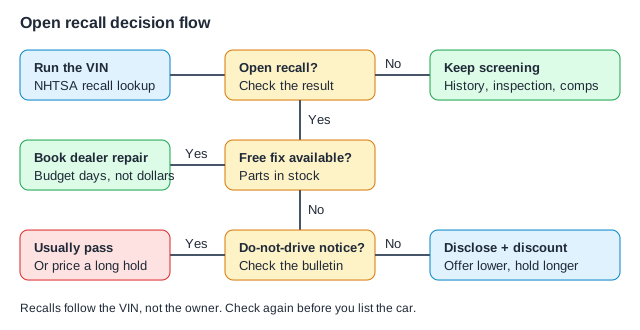
| No open recalls | Nothing outstanding for that VIN right now | Keep screening, and check again before listing |
| Open recall, remedy available | Free dealer fix exists | Book it, or negotiate for the time and hassle |
| Open recall, remedy not yet available | Parts or procedure still pending | Treat as a long hold, a big discount, or a pass |
Watch for “do not drive” notices
Some recalls come with a stronger warning, such as a “do not drive” or “park outside” instruction for certain fire or airbag risks. Read the bulletin for any recall on your target car. If a notice tells owners to stop driving the vehicle until it’s fixed, you shouldn’t be test-driving it, transporting it on its own wheels, or letting a buyer do so.
For those cars, the safe default is a pass, unless the fix is available, quick, and confirmed by the dealer before you commit.
Recalls and your flip math
Recall repairs are free to the owner, so the dollar cost is often zero. The real cost is time and friction.
Add these to your numbers before you make an offer:
- A dealer appointment. You may wait days or weeks for a slot at a franchised dealer, and you’ll need to get the car there.
- Holding costs. Every extra week you hold the car costs insurance, storage, and the money tied up in it. Our guide on calculating car flipping profit shows how to include those costs in your walk-away number.
- A discount for the hassle. If the seller hasn’t dealt with it, that’s a legitimate negotiating point. Mention that the car needs a dealer visit before it can be sold with confidence. Our post on negotiating with a private car seller covers how to bring it up without souring the deal.
If the remedy isn’t available yet, the cost shifts from a few days to an open-ended wait. Most small-volume flippers shouldn’t pay for that uncertainty. Plenty of other cars don’t come with it.
Can you legally sell a car with an open recall?
Rules differ by situation, so treat this section as general information rather than legal advice.
Federal law bars dealers from selling new vehicles with open recalls. For used vehicles, the picture is looser: the proposed Used Car Safety Recall Repair Act would require used-car dealers to fix recalls before selling, but it has been introduced as a bill and, as far as we could confirm, isn’t law. Check Congress.gov for its current status.
Some states and lenders have their own rules, and advertising a used car as “safe” or “inspected” while ignoring open recalls can invite scrutiny. If you sell more than a few cars a year, our overview of car flipping laws by state is a good place to start, and a local attorney or your state’s dealer regulator can answer the specifics.
The practical standard, whatever the law says: don’t sell a car with an unresolved recall without telling the buyer in writing. Put the recall status in your listing, mention it when you talk, and note it on the bill of sale.
A repeatable recall routine
Here’s the routine that keeps recalls from becoming surprises:
- At lead screening: Ask for the VIN in your first message. Run the recall lookup before you do anything else.
- Before the offer: Price in the dealer visit and any waiting time, or walk away if the remedy isn’t available.
- After purchase: Book the repair right away. Don’t let the car sit while you work on cosmetics.
- Before listing: Run the VIN again, save the screenshot, and say in the listing that recalls have been checked and addressed.
- At sale: Hand the buyer the dealer’s repair invoice along with the rest of the paperwork.
That last step is a quiet selling point. A listing that says “all open recalls completed, paperwork included” stands out from the pile of “runs great, no issues” ads.
Frequently asked questions
Is the NHTSA recall check free?
Yes. The federal recall lookup by VIN is free, and so are the repairs on an open recall. The only costs are your time and getting the car to a dealer.
Do I need to take the car to the original dealer?
No. Any franchised dealer of that brand can generally perform the recall work, regardless of where the car was originally sold. Call ahead to confirm parts availability.
Should I skip every car with an open recall?
No. A recall with an available remedy is often a manageable chore. Pass when parts aren’t available, when the notice says not to drive the car, or when the seller won’t give you time to get it fixed.
Screen smarter, waste less time
Every recall check you do early saves hours later. The faster you spot a car worth a closer look, the more time you have to run the VIN, call the dealer, and negotiate. Flipify Motors watchlists alert you to new listings that match your criteria, and here’s how it works if you want to see the setup. Then run the VIN, check the recalls, and only chase the cars that survive.

