How to Negotiate With a Private Car Seller (Without Losing the Deal)
Learn how to negotiate with a private car seller: set your number, make the first offer, use inspection findings as leverage, and know when to walk away.

For a car flipper, every dollar you shave off the purchase price goes straight to your bottom line. Sell a car for the same price either way and a $700 better buy is $700 more profit.
Private sellers are also the best people to negotiate with. There’s no sales manager, no add-on fees, and no script. There’s just a person who wants to sell a car. The catch is that they’re a person, so how you negotiate matters as much as what you offer.
Here’s a practical approach to negotiating with a private car seller that works for flippers and everyday buyers alike.
Step 1: Settle your number before you message anyone
Negotiating without a number is just haggling. Before the first message, know two figures:
- Your target price: what you’d love to pay.
- Your walk-away price: the most you can pay and still hit your profit goal.
Work the walk-away price backward from the resale value, the way we do in how to calculate car flipping profit. Subtract your profit target, recon, fees, and a buffer from the expected sale price. Whatever is left is your ceiling.
Then back your target up with evidence. Pull three to five comparable listings and note their mileage, condition, and how long they’ve been up, as covered in how to tell if a used car is a good deal. Real comps turn “I want a discount” into “similar cars are listed at $X.”
Step 2: Use timing and listing age as leverage
Cars that sit are cars that get discounted. iSeeCars found in 2013 that about 1 in 5 used cars for sale had its price reduced by nearly 7% on average before it sold. That’s an older study of dealer-style listings, so treat it as a rough benchmark rather than a promise, but the pattern holds up: asking prices are a starting point.
The market is also slower than it was. The average 1- to 5-year-old used car took 53 days to sell in February 2026, up from about 38 days a year earlier, according to iSeeCars data. That’s dealer-listing data, not private sales, but more days on market generally means sellers feel more pressure.
What to look for in a listing:
- Posted three or more weeks ago
- A price drop already shown
- Phrases like “must sell,” “moving,” or “need gone”
- Poor photos or a thin description (fewer buyers see it)
You’ll find these faster with saved searches and alerts. Our watchlists are built for this, and our guide to finding underpriced cars on Facebook Marketplace shows how to spot the listings worth chasing.
Step 3: Make the first offer (and make it count)
Opening offers are where most buyers either insult the seller or leave money on the table.
Don’t lowball in a first message. A 40%-off text usually gets ignored or blocked. Instead:
- Confirm the car is available and ask a question or two.
- Ask how flexible they are on price once you’ve seen it.
- Make your real offer in person, after the walkaround.
When you do make an offer, be specific and reasonable. “I can do $7,400 cash today, and I can pick it up this evening” lands better than “What’s your lowest?” It also shows you’re a serious buyer, which is worth a lot to a seller tired of no-shows.
A few more habits that help:
- Say the number once, then stop talking. Silence does the work.
- Never reveal your ceiling. If they ask your budget, say you’re comparing a few cars.
- Offer something besides price. Fast pickup, cash, or taking the car as-is can be worth real money to a seller.
Step 4: Let the inspection do the negotiating
Your strongest leverage is a documented problem. Walk the car with a checklist, and if anything turns up, price it.
| Finding | What to do |
|---|---|
| Worn tires | Get a quote for a set; deduct it |
| Warning lights or codes | Scan it; get a repair estimate before offering |
| Overdue maintenance | Deduct the service cost |
| Body or paint damage | Get a body-shop quote or use recon estimates |
| Title or history surprise | Re-check the whole deal, or walk |
Don’t wave vague complaints around (“it needs some work”). Say “The front tires are at 3/32 and the brakes are squealing, which is about $900 to fix. I can do $7,100.” Specific, checkable, and hard to argue with. If you have a reconditioning budget, our guide to car reconditioning costs for flippers will help you quote repairs accurately.
For a car you’re serious about, a pre-purchase inspection from an independent mechanic is cheap leverage. It also protects you from history reports that miss things.
Step 5: Counter smartly, then be willing to walk
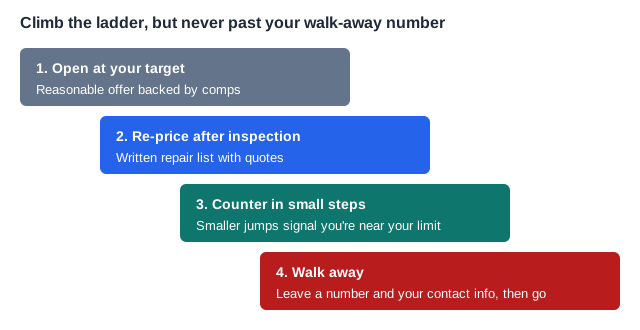
Expect the seller to counter. The goal is to move in smaller and smaller steps toward a number you can live with.
Say your target is $7,000 and your walk-away is $7,600:
- Offer $7,000. The seller counters at $8,200.
- You go to $7,300 and explain why (tires, brakes).
- They counter at $7,900.
- You go to $7,500, and say it’s your best.
Shrinking jumps tell the seller you’re near your limit. Big jumps tell them there’s more in the tank.
If the seller won’t reach your walk-away number, leave politely. Say: “I understand. If anything changes, here’s my number.” Many sellers call back within a few days, especially if the car hasn’t had other offers. And if they don’t, you’ve saved yourself from a bad flip.
Common negotiation mistakes
- Falling in love with the car. Emotional attachment is a tax. There are always more cars.
- Skipping the math. Negotiating a price below asking isn’t the same as getting a price that makes you money.
- Negotiating before you’ve seen the car. You can’t point to real issues yet.
- Being rude. Respect gets you further than aggression, and sellers talk to each other in local groups.
- Ignoring the paperwork. A great price on a car with a messy title is not a great price. See car flipping laws by state before you hand over cash.
Frequently asked questions
How much below asking price should I offer on a private-party car?
There’s no universal number, since it depends on how the price compares with comps. If the car is already priced at or under market, a small discount is realistic. If it’s priced well above comparable listings, a larger gap is fair, as long as you can show your comps.
Is it okay to negotiate over text?
For the basics (availability, a price check), yes. Keep real price talk for in person, once you’ve seen the car and can point to specific issues.
Should I pay in cash?
Cash is attractive to sellers, but safety matters. Meet in a public place or at the seller’s bank, and don’t carry large amounts to an unfamiliar address. Get a signed bill of sale and the title at the same time.
When should I walk away?
When the seller won’t reach your walk-away number, or when something new (a title issue, a lie about accidents) changes the deal. A good flip depends on a good buy.
Negotiate from a position of strength
The best negotiators aren’t the best talkers. They have the best information: the comps, the walk-away number, and a car they found before everyone else did. Flipify Motors helps with that last part by surfacing fresh listings fast. See how it works to get started.