Car Bill of Sale for Flippers: What to Include When You Sell As-Is
A car bill of sale protects you when you flip as-is. Learn what to include, what states require, and the paperwork mistakes that cause disputes.

You found the car, fixed what mattered, and wrote a listing that sells fast. The buyer shows up with cash. Then comes the part nobody posts photos of: the paperwork.
A signed title moves ownership. A car bill of sale is what protects you if the buyer calls two weeks later claiming the transmission was “misrepresented.” For anyone selling more than the occasional car, it’s the cheapest insurance in the business.
This guide covers what to put on a bill of sale for an as-is flip, what your state may require, and the mistakes that turn simple sales into disputes.
What a bill of sale does (and doesn’t do)
A bill of sale is a written receipt for the transaction. It records who sold what to whom, for how much, and on what terms.
It does not transfer ownership. That’s the job of the certificate of title, which you sign over to the buyer. Think of the title as proof of who owns the car and the bill of sale as proof of what you agreed to.
Here’s why that second part matters for flippers:
- It shows the exact sale date, which helps if the buyer racks up tickets or an accident before registering the car.
- It documents the odometer reading you disclosed.
- It puts the “as-is” terms in writing, so you’re not relying on a verbal agreement.
- It gives you a record for your books and for calculating your real profit at tax time.
What to include on the bill of sale
Keep it to one page. Short, specific documents are easier to defend than long, legalese-heavy ones.
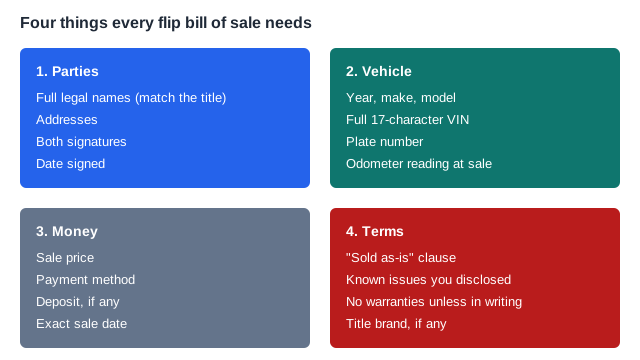
Parties
- Seller and buyer full legal names (the seller’s name should match the title)
- Addresses for both
- Signatures and the date signed
Vehicle
- Year, make, and model
- The full 17-character VIN, copied from the car itself, not typed from memory
- License plate number
- Odometer reading at the time of sale
Money
- Sale price
- Payment method (cash, cashier’s check, wire)
- Any deposit already paid
- The exact date of sale
Terms
- A plain as-is clause, for example: “The vehicle is sold as-is, with no warranties expressed or implied.”
- Any issues you disclosed, such as a known leak, a warning light, or a branded title
- Any promise you did make, written down exactly. If you told the buyer “the AC was recharged last month,” put it in or leave it out of the conversation
Save the bill of sale as a template you reuse for every deal, and keep each signed copy with the car’s record in your inventory tracker, so you’re never improvising at the curb.
“As-is” in a private sale: what it actually means
Most states treat private used-car sales as as-is by default, but putting it in writing removes the guesswork. NerdWallet’s guide to writing a car bill of sale recommends including accident and major-repair history along with the as-is wording.
As-is has limits, though. It generally won’t protect you if you actively lie about something material, like saying a car has never been in an accident when you know it has. Disclose what you know and let the buyer inspect. Honest paperwork is your best defense.
Are you a “dealer” under federal rules?
This is where flippers can get caught out. The FTC’s Used Car Rule defines a dealer as a person who sold five or more used vehicles in the previous 12 months. Dealers must post an FTC Buyers Guide on each car, stating whether it’s sold as-is or with a warranty. An informal “as-is” line on a bill of sale doesn’t replace it.
If you’re flipping at volume, read our breakdown of car flipping laws by state before you list your sixth car. State dealer-licensing limits are often lower than the federal threshold.
What your state may require
Bill of sale rules vary, and they change. Treat these as examples, then confirm with your DMV:
| Topic | What to expect |
|---|---|
| Required to register? | Varies by state. One state-by-state roundup, updated in July 2026, lists about eight states (including New York, New Jersey, and Connecticut) where a privately bought car needs one to title or register. |
| Notarization | Rare. The same roundup says only Louisiana and West Virginia require the bill of sale itself to be notarized. |
| State forms | Many DMVs publish a free official template. Florida, for example, uses Form HSMV 82050. |
| Seller notifications | Some states make you report the sale. California sellers must notify the DMV within five calendar days using the Notice of Transfer and Release of Liability. |
That last row is the one flippers forget. If you skip a seller-side notification, the car can stay tied to your name. Parking tickets, toll bills, or worse can land on you after the buyer drives away.
Even if your state doesn’t require a bill of sale, use one. It costs nothing.
The paperwork routine for every flip
Do the same thing every time and you’ll rarely get burned.
- Print two copies of your bill of sale before the buyer arrives.
- Check the buyer’s ID and make sure the name matches what goes on the paperwork.
- Verify the VIN on the dash against the title and the bill of sale.
- Photograph the odometer at handover, with the buyer present.
- Sign the title exactly as your state requires. Don’t leave anything blank, and don’t hand over an “open” title.
- Both parties sign the bill of sale; each keeps a copy.
- Remove your plates if your state requires it.
- File any seller notification (release of liability, sold notice) the same day.
- Scan everything and store it with the deal’s receipts. Keep records for at least as long as your tax adviser recommends.
If you bought the car from a private seller, you were on the other side of this process not long ago. Your own negotiation notes and the original seller’s signed bill of sale are the start of your paper trail.
Common bill of sale mistakes
- Using someone else’s name. “Title jumping,” where you sell a car before ever titling it in your name, is illegal in many states. Our laws guide explains why titling matters.
- Skipping the odometer. Federal law requires an odometer disclosure on the title transfer. Match your bill of sale to it.
- Vague descriptions. “2015 Honda” isn’t enough. Include trim and VIN.
- Forgetting known issues. If the car has a branded title or a flagged history, say so. See our post on flipping rebuilt title cars for how branded titles change the conversation.
- Accepting risky payment. Cash or a cashier’s check verified at the buyer’s bank beats a personal check or a payment app with reversal risk.
- Rushing. A buyer who pressures you to skip signatures or leave the price blank is a red flag.
Frequently asked questions
Do I need a bill of sale to sell a car?
Not always. Many states don’t require one for private sales. You should still use one because it documents the sale date, price, and as-is terms.
Does a bill of sale replace the title?
No. The title transfers ownership. The bill of sale is supporting proof of the deal and its terms.
Does the bill of sale need to be notarized?
In most states, no. Notarization of the bill of sale is uncommon, though the title itself may need notarized signatures in some places. Check your state’s DMV.
Can I use a free online template?
Yes, but compare it with your state DMV’s version first. Many templates are generic or poorly written, and an official form is the safest base.
How long should I keep it?
Keep the bill of sale, a copy of the title, and your receipts for as long as you’d keep other tax records. Ask a tax professional for the right period for your situation.
Keep the paperwork boring
The best sale is one nobody thinks about again after the keys change hands. Do the paperwork the same way every time, and spend your energy on finding the next good deal. Flipify Motors watches listings for you so you can stay ahead of the market. See how it works to get started.
This article is general information, not legal advice. Check your state’s DMV or a local attorney for current requirements.