Facebook Marketplace Vehicle Sourcing: A Repeatable System for Dealers and Flippers
Turn Facebook Marketplace into a steady vehicle sourcing channel: set a buy box, monitor new listings, triage fast, make offers, and close private-party deals safely.

Most independent dealers and car flippers source inventory from the same few places: auctions, trade-ins, wholesalers, and private sellers. Of those, private sellers usually leave the most margin on the table, and Facebook Marketplace is where most private sellers now list their cars.
The catch is that Marketplace wasn’t built for sourcing. There’s no bulk view, no condition report, and no bidding floor. Every deal is one seller, one conversation, and one inspection. Buying a car there now and then is easy. Turning it into a reliable channel that produces cars every week takes a system.
This guide covers how to build that system: what to buy, how to see the right listings first, how to sort deals quickly, and how to close private-party purchases without paperwork surprises.
Why source vehicles from Facebook Marketplace?
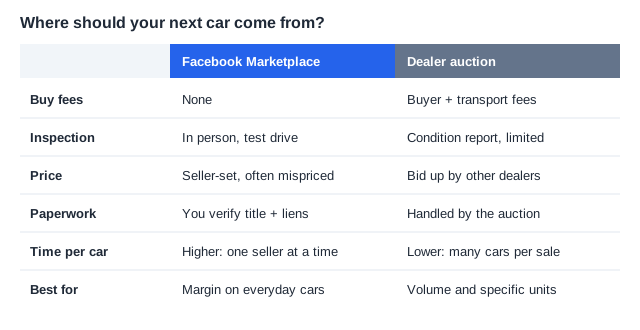
Auctions are efficient. You can look at hundreds of cars in a day and the paperwork is handled for you. But every car there is bid on by other dealers, and you pay buyer fees and transport on top of the hammer price.
Marketplace works the other way around:
- Prices are set by sellers, not by a room of dealers. Private sellers price based on what they owe, a guess, or how fast they need the money. Some guess low.
- There are no buyer fees. The asking price is the price, before negotiation.
- You can inspect and drive the car. You see exactly what you’re buying, rather than relying on a condition report and a few photos.
- The cars are often local. Less transport cost, and the history usually matches the region your buyers live in.
The trade-off is time. Each car takes messaging, driving, and inspecting, and many of those leads won’t turn into a purchase. That’s why the dealers who do well here treat it as a pipeline with stages, not a scroll through listings.
Step 1: Define your buy box
A buy box is the short list of vehicles you’ll buy, along with the limits on each. Without one, you end up chasing every interesting listing and valuing cars you don’t know well.
For each target vehicle, write down:
- Make, model, and year range. Stick to cars you know how to price and recondition.
- Maximum mileage.
- Maximum purchase price. Work back from your expected retail price, minus reconditioning, fees, and your target profit. Our car flipping profit guide walks through the math.
- Title status. Clean only, or are you set up to handle rebuilt titles?
- Deal-breakers. For example, no manual transmissions, no frame damage, no aftermarket lift kits.
- Radius. How far you’ll realistically drive to look at a car on short notice.
Most small operations do best with three to eight entries. Common, easy-to-resell vehicles like commuter sedans, midsize SUVs, and half-ton trucks tend to move faster than niche cars, even if the margin per car is smaller.
Step 2: Watch for new listings, not old ones
In a decent market, the best-priced private-party cars are usually gone within hours. If you only check Marketplace when you have time, you’ll mostly see the cars other buyers passed on.
There are three ways to keep up, from least to most reliable:
- Manual saved searches. Set up a Vehicles search for each buy box entry, sort by Date listed: newest first, and check it several times a day. Free, but it depends on you remembering.
- Facebook’s own notifications. Marketplace can alert you to some new listings, but the alerts can be delayed and you can’t set detailed criteria. Our guide to Facebook Marketplace car notifications explains what to expect.
- Automated watchlists. This is what Flipify Motors does. You turn each buy box entry into a watchlist with make, model, years, price, mileage, transmission, and distance. Flipify Motors checks new listings around the clock and sends a push notification with the price, mileage, and distance as soon as a match appears.
Whichever you choose, the aim is the same: see every new car that fits your buy box within minutes of it being posted.
Keyword searches are worth adding too. Misspelled model names, “must sell,” “moving,” and “needs battery” turn up listings that filtered searches miss. The underpriced cars guide has more of these.
Step 3: Triage each listing in under two minutes
When an alert comes in, you need to decide quickly whether it’s worth a message. A simple triage routine:
- Does it fit the buy box? If the mileage, title, or transmission is wrong, move on.
- How does the price compare? Check it against similar local listings first, then a pricing guide’s private-party range. Flipify Motors shows comparable listings next to a match when they’re available.
- What do the photos show? Look for mismatched panels, warning lights on the dash, rust, worn interiors, and anything the seller cropped out.
- What does the description leave out? No mileage, no mention of the title, or “runs good, just needs…” are all worth asking about.
- Can you afford to be wrong? Estimate reconditioning on the high side. If the deal only works when nothing goes wrong, it probably isn’t a deal. See our reconditioning cost guide for typical numbers.
If a listing passes, message right away. A good message sent an hour late usually loses to a plain one sent in the first few minutes.
Step 4: Message like a ready buyer
Sellers on Marketplace get flooded with “Is this still available?” and lowball offers. The buyers who get replies sound specific, local, and ready to act:
Hi, I’m interested in your 2016 RAV4. I can come see it today between 5 and 7 and pay on the spot if it checks out. Is the title in your name, and is there a loan on it?
That message does three things. It shows you can move quickly, it names a time, and it asks the two questions that most often kill a private-party deal: title and lien.
A few habits help:
- Be upfront that you buy cars regularly if you’re a dealer or a frequent flipper. Many sellers like a quick, certain sale, and being honest about it builds trust.
- Don’t negotiate in the first message. Save it for when you’re standing next to the car and can point to real issues.
- Keep a few message templates for your common buy box vehicles so you can respond in seconds, then tweak them for each listing.
Step 5: Inspect, value, and make an offer
Before you drive out, ask for the VIN and run a history report. It’s quicker to rule a car out from your desk than in someone’s driveway.
At the car, follow the same routine every time:
- Match the VIN on the dash, the door-jamb sticker, and the title.
- Check for leaks, warning lights, and stored codes with an OBD-II scanner.
- Test drive from a cold start if you can, including highway speed.
- Look closely at tires, brakes, glass, and body panels. These are the most common reconditioning costs.
Then make one clear offer based on your numbers, and explain it: “Comparable cars are around $11,500, it needs four tires and a windshield, so I’m at $9,200 today.” Sellers accept a reasoned offer far more often than a bare number. If they won’t move to a price that works, thank them and leave your number. Unsold cars often come back a week later.
Step 6: Close the deal and handle the paperwork
Private-party purchases put the paperwork on you. Getting it wrong is how a profitable car becomes a problem you can’t sell.
- Check the title is in the seller’s name and matches their ID. Avoid open titles, where the seller is passing on a title signed by someone else.
- Confirm whether there’s a lien. If there’s a loan, the safest route is to complete the sale at the seller’s bank or credit union, or to pay the lender directly and get a lien release in writing.
- Use a bill of sale with the date, price, VIN, odometer reading, and both parties’ signatures, even if your state doesn’t require one.
- Pay in a traceable way. A cashier’s check or bank transfer leaves a record. Large cash payments in a parking lot don’t.
- Meet somewhere safe. A bank or a police station’s safe exchange zone works well.
Title and registration rules vary by state, and so do the limits on how many cars you can sell before you need a dealer license. If you’re scaling up, read our overview of car flipping laws by state.
Step 7: Track the funnel
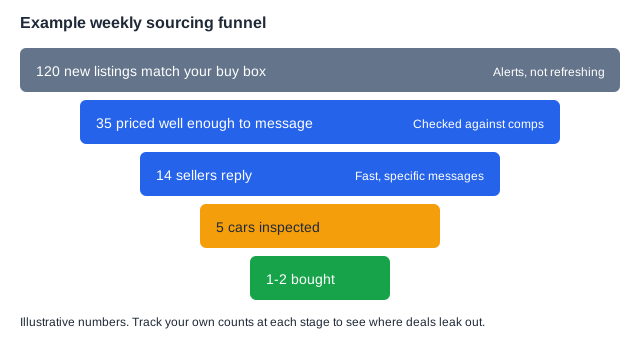
Once Marketplace is a regular sourcing channel, track a few numbers each week:
- Matches: new listings that fit your buy box.
- Messages sent: listings priced well enough to contact.
- Replies: sellers who responded.
- Inspections: cars you went to see.
- Purchases: cars you bought, and what you paid compared with your target.
Each stage tells you something different. Lots of matches but few cars worth messaging means your buy box prices are too low for your market. Lots of messages but few replies usually means you’re too slow or your messages sound like everyone else’s. Lots of inspections but few purchases points to listings that look better online than they are, so tighten your triage.
Then compare your cost per car here with what you pay at auction once fees, transport, and your time are included. For most small dealers, Marketplace won’t replace auctions, but it can supply the higher-margin part of the lot.
Frequently asked questions
Can dealers buy cars on Facebook Marketplace?
Yes. Marketplace has no rule against dealers buying from private sellers. Be honest that you buy cars regularly, follow your state’s title and dealer rules, and complete the purchase the same way any careful private buyer would.
Is Facebook Marketplace better than auctions for sourcing cars?
They serve different purposes. Auctions offer volume and handle the paperwork, but prices are competitive and fees add up. Marketplace takes more time per car, but private sellers sometimes price below market and there are no buyer fees. Many dealers use both.
How do you find cars on Facebook Marketplace before other dealers?
Speed is the main advantage. Set up searches for each vehicle you want, sort by newest first, and use alerts so you know about a new listing within minutes. Tools like Flipify Motors watch for new matches continuously and send a push notification as soon as one appears.
What should you check before buying a car from a private seller?
Run the VIN history, confirm the title is in the seller’s name, find out whether there’s a loan on the car, check that the VINs match, scan for trouble codes, and test drive it. Use a bill of sale and pay with a traceable method.
Build the pipeline once, then let it run
Facebook Marketplace vehicle sourcing rewards buyers who are organized and fast. Define your buy box, see new listings as soon as they’re posted, triage quickly, and close cleanly. Do that every week and Marketplace becomes a dependable source of inventory rather than an occasional lucky find.
Set up your first watchlist in Flipify Motors to get notified the moment a car in your buy box is listed. New to buying for resale? Start with how to flip cars for profit.