
Car Reconditioning Costs for Flippers: What to Fix Before You Sell
Car reconditioning costs can erase a flip's profit. Learn what's worth fixing, what to skip, and how to budget recon before you buy.
Most flips don’t fail at the purchase. They fail in the driveway, when a “few small fixes” turns into a $1,500 bill and three extra weeks of holding the car.
Reconditioning, or “recon,” is everything you do between buying a car and listing it: cleaning, repairs, safety items, and cosmetic touch-ups. Get it right and a tired car sells fast at a fair price. Get it wrong and you’ve donated your profit to a parts store.
This guide shows how to budget recon before you buy, what’s worth fixing, and what to leave alone.
How much does reconditioning really cost?
Professionals spend more than most beginners expect. The National Independent Automobile Dealers Association (NIADA) reported that independent dealers’ recon costs rose from about $1,160 per car in 2022 to north of $1,300 in early 2023, and kept climbing through the year.
Dealers have shop labor, parts discounts, and sometimes in-house techs, so a solo flipper shouldn’t assume a lower number. Plan on a range, not a hope:
| Car condition at purchase | Typical recon budget |
|---|---|
| Clean, well-kept, needs a detail | $150 to $400 |
| Average: worn tires or brakes, small cosmetic flaws | $500 to $1,200 |
| Rough: multiple repairs, warning lights, dents | $1,500+ (usually a pass) |
Those tiers are our rule-of-thumb planning ranges, not survey data. Your local labor rates and parts prices will move them, so price real jobs in your area.
Step 1: Budget recon before you buy
Recon belongs in your buy price, not in your surprise pile. Build it into the formula from our guide on how to calculate car flipping profit:
Max offer = expected sale price − recon − fees − your target profit
Then do a quick walk-around and list every flaw:
- Tire tread and age (check the DOT date code)
- Brake feel, squeal, and rotor lip
- Dash warning lights and a quick OBD scan
- Dents, scratches, and mismatched paint
- Smells, stains, and sun-damaged trim
- Leaks under the car
Price each item with a real quote or a parts-store lookup. If you can’t estimate it, add a buffer, or walk away like you would with a risky branded title.
Step 2: Fix, fix cheaply, or skip
Not every flaw deserves money. The question is simple: will the buyer pay more than the fix costs, or will the flaw stop the car from selling?
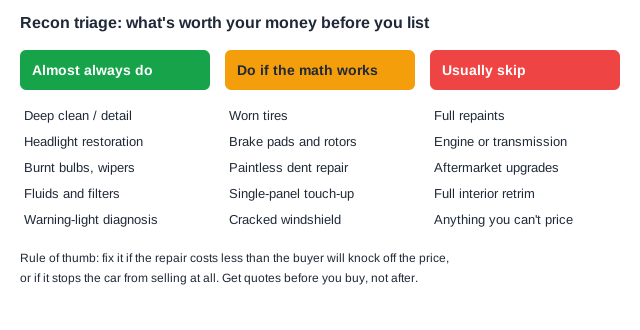
Almost always worth it
A deep clean. It’s the highest-return recon job there is. Shampoo seats and carpets, clean the glass inside and out, wipe every surface, and remove odors. Buyers judge a car’s whole history by how it looks and smells in the first 30 seconds. Industry detailing sites claim a proper detail can lift resale value by a few percent, but treat that as a vendor claim. What’s certain is that a $200 detail rarely costs more than the price cut a dirty car invites.
Cheap safety and “looks neglected” items. Burnt bulbs, wipers, a missing gas cap, foggy headlights. Each is under $50, and each makes buyers wonder what else was ignored.
Diagnosing warning lights. A check-engine light can scare away half your buyers and scare the other half into lowball offers. A $100 scan often turns a mystery into a $40 sensor.
Do it if the math works
Tires and brakes. Buyers and inspectors both check them. If tires are near the wear bars, budget for a replacement or discount the car by the full cost. Mid-priced tires are better than premium ones for a flip; nobody pays extra for a name brand on a $9,000 car.
Paintless dent repair (PDR). Small dings with intact paint often cost far less than bodywork. Get a quote first.
Windshield chips. Many can be filled cheaply, and insurance sometimes covers it. A full crack is a judgment call.
Usually skip
- Full repaints. Rarely recouped, and fresh paint makes savvy buyers suspect an accident.
- Major mechanical work on a car you can’t resell above retail. Walk away or buy it cheaper.
- Aftermarket upgrades. Wheels and audio rarely add value for the average buyer.
- Anything you can’t price. If a mechanic says “could be the transmission,” your budget is a coin flip.
Step 3: Watch the clock, not just the receipt
Money isn’t the only recon cost. Every extra day the car sits in your driveway is a day of insurance, depreciation, tied-up cash, and a market that might move.
Three habits keep recon from dragging on:
- Line up parts and appointments before you buy. Know which shop does PDR and which tire place can fit you in this week.
- Set a recon deadline. Seven days from purchase to listing is a good target for a simple flip.
- Set a spending cap. Dealers often use an “auto-approve” threshold so small jobs don’t stall; Cox Automotive’s guidance describes baseline limits of roughly $600 to $800 per car. Pick your own number, and stop to re-run the math before crossing it.
Step 4: Document everything
Keep receipts and take before-and-after photos. Records make your listing more credible and justify your asking price. Mention the work in the description: “New front brake pads and rotors, professionally detailed, service records available.”
Then price against the market, not your costs. Buyers don’t care what you spent; they care what similar cars sell for. Our post on how to tell if a used car is a good deal shows how to check comps.
The cheapest recon is a better car
The best way to cut recon costs is to buy cars that don’t need much. A clean, well-kept car at a modest discount often beats a rough car at a deep one, once repairs and extra days are counted.
That’s why speed and selection matter. When you see new listings first, you get to choose the clean cars before other buyers do. Flipify Motors watchlists alert you when Marketplace listings match your criteria, and our guide to finding underpriced cars on Facebook Marketplace covers how to spot the real deals.
Frequently asked questions
How much should I budget for reconditioning a flip?
A common planning range is $150 to $400 for a clean car and $500 to $1,200 for an average one. Dealers averaged over $1,300 per car in 2023 according to NIADA, so don’t assume your recon will be free.
Is detailing worth it before selling a car?
Almost always. It’s cheap compared with most repairs, and a clean car photographs, shows, and negotiates better.
Should I fix every problem before selling?
No. Fix what buyers will notice and what blocks a sale. Disclose the rest honestly and discount for it.
Do I need to disclose repairs?
Disclose known defects and prior damage as your state requires. Check your local rules, and see our overview of car flipping laws by state.
Dollar ranges in the tables are illustrative planning figures. Check local pricing before you buy a car.
