How to Search All Marketplace for Used Cars
Learn how to search all marketplace sites for used cars at once, with saved criteria, one deduplicated feed, and alerts that reach you first.

You have the tabs open right now. AutoTrader in one, Facebook Marketplace in another, a Craigslist search you forgot to close, and a screenshot on your phone of a car you can’t find again. Two of those tabs are the same vehicle at two different prices listed by two different people, and the third was sold yesterday.
That’s the shape of a cross-marketplace vehicle search. Finding listings stopped being the hard part. The hard part is what happens after the matches land: deciding which of the six listings for one car is genuine, what each is worth once you’ve adjusted for mileage, currency and distance, and whether the person holding the keys owns the thing.
Broader coverage makes the search easier and the decision harder. Discovery is the first half of the job. Deduplication, price normalization and verification are the second, and it’s the half most buyers skip.
Choose the Marketplaces Worth Searching
In 2024, 90% of U.S. buyers surveyed by CarGurus researched vehicles online, up from 81% in 2023, according to the CarGurus 2024 car-shopper study. Shopping moved online faster than any single site could absorb it. Industry estimates put U.S. used-vehicle sales at about 42.2 million units a year against 15.4 million new vehicles, roughly 2.7 used sales for every new one, per DataIntelo’s used-car market research, and those listings are scattered across dealer sites, classified marketplaces, social platforms and auction channels rather than collected in one place.
That scattering is the reason a search all marketplace habit earns its keep. It’s also the reason adding sources has a ceiling. Every marketplace you switch on adds matches, duplicates, currencies and seller types, and the second and third of those cost more time than the first saves.
The Coverage Map
Six sources cover most of what a North American buyer can realistically act on. They aren’t interchangeable, and the differences matter more than any feature list suggests.
| Marketplace | Coverage | Best for | Watch-out |
|---|---|---|---|
| Facebook Marketplace | Worldwide, organized by local area | Private sellers and local deals | Saved-search alerts can arrive late, and seller history is thin |
| AutoTrader.ca | Canada | Dealer and private inventory in Canada | Prices are in CAD, so convert before comparing |
| AutoTrader.com | US | Broad dealer inventory | Dealer prices often include markup over private sales |
| Craigslist | US and Canada | Private sellers and lower asking prices | Frequent duplicate posts and the highest scam exposure |
| OfferUp | US | Local private sales | Local pickup only, and good cars sell quickly |
| eBay Motors | US | Auctions and fixed-price listings | Auction fees and bid timing change the real price |
Choose by Collection, Not by Count
The rule I’d give anyone building a first cross-market search is simple: pick sources by where you can physically inspect and collect the car.
A buyer in Ontario gains little from eBay Motors auctions in Texas once transport and import paperwork enter the deal. A buyer in Ohio gains nothing from AutoTrader.ca except a currency conversion exercise. Every source you can’t act on is pure verification overhead.
Start with two or three that cover your own city and the metros within a day’s drive. Facebook Marketplace earns a slot on nearly every shortlist because private sellers tend to list there first, though its alerts are the weakest link, so it’s worth understanding how Facebook Marketplace vehicle sourcing behaves in practice before you lean on it. Add Craigslist or AutoTrader.com for price spread, then leave eBay Motors and OfferUp until your deduplication habit is stable and a fourth feed won’t drown the first three.
How to Build One Saved Search Across Sites
A saved search is a standing instruction, and every site wants it phrased differently. AutoTrader.com asks for a radius in miles, Craigslist asks for a region and a category, Facebook Marketplace leans on a distance slider that resets more often than you’d like. Write the search once in plain language before you enter it anywhere.
-
Write the target list first. Make, model, two or three year ranges, plus keyword variants for trim names, engine codes and the misspellings sellers type. Three to five variants per model is plenty; a keyword list that runs to twenty terms buries real matches under parts ads.
-
Set location and radius to the tightest setting every site supports. If one marketplace caps at 100 miles and another allows 25, set 25 where you can and check the wider one manually once a week. Radius is the filter people leave generous, and it’s the one that fills a feed with cars you’ll never drive to see.
-
Enter the hard limits: maximum price, mileage ceiling, transmission. A missing ceiling lets every listing through. Use your all-in number rather than the sticker you’re comfortable with, because tax, transport and a safety inspection land on top of the asking price.
-
Keep soft criteria in a note beside the search, not inside it. Seller type, days listed, whether the history report is attached, photo quality. None of these should block a listing; all of them should change the order you review it in.
-
Choose which marketplaces that particular search runs on. Keep a separate search per vehicle type and enable only the sources that carry it, so a truck search isn’t fed by a marketplace where trucks barely appear.
-
Save it as a watchlist, one per strategy. A budget commuter, a low-price flip candidate and an enthusiast project have different ceilings and different tolerance for mileage, and mixing them produces a feed nobody can prioritize.
The slip that kills a saved search: leaving the year range blank and planning to “scan” the results. You won’t.
The five moves that keep a cross-site search manageable are the same whether you’re running two sources or six.
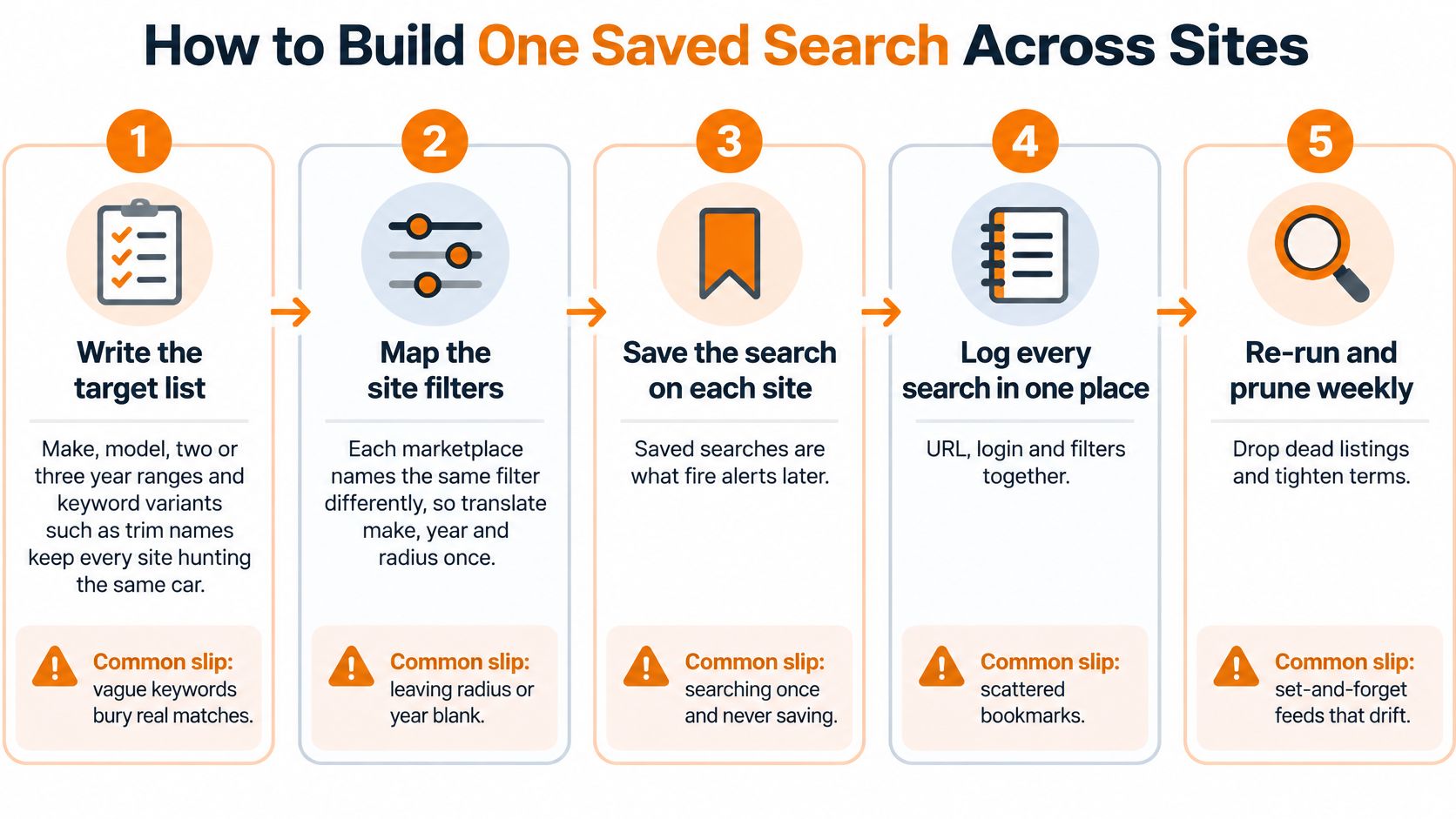
Saving rather than re-entering is the point of the exercise. A watchlist keeps the radius, price ceiling and other criteria together, so you don’t rebuild the search every Monday and lose track of what you already reviewed.
| Criterion | Type | Example setting | Why it matters |
|---|---|---|---|
| Make and model | Hard | 2019 to 2022 Honda CR-V | Stops unrelated listings from reaching your feed |
| Location and radius | Hard | 75 miles from home | Keeps you within a drive you would actually make |
| Maximum price | Hard | Your all-in ceiling, not the sticker | Prevents chasing cars you cannot afford after fees |
| Mileage ceiling | Hard | Under 80,000 miles | Filters high-wear cars before you open them |
| Transmission | Hard | Automatic only | Avoids a manual you do not want |
| Seller type | Soft | Dealer or private | Ranks cars by the risk and negotiation style you accept |
| Listing age | Soft | Under 14 days old | Ranks fresh listings above stale ones |
| History completeness | Soft | Title and accident report shown | Ranks listings you can verify faster |
Revisit those criteria whenever a source starts producing noise. Nine times out of ten the fix is a tighter mileage ceiling or a cap on listing age, not another marketplace.
Merge, Deduplicate and Verify Every Match
The second marketplace you add is the moment duplicates start arriving. Searching six sources for the same CR-V does not produce six times the cars; it produces the same cars wearing six different URLs, and every copy lands in your feed asking to be judged.
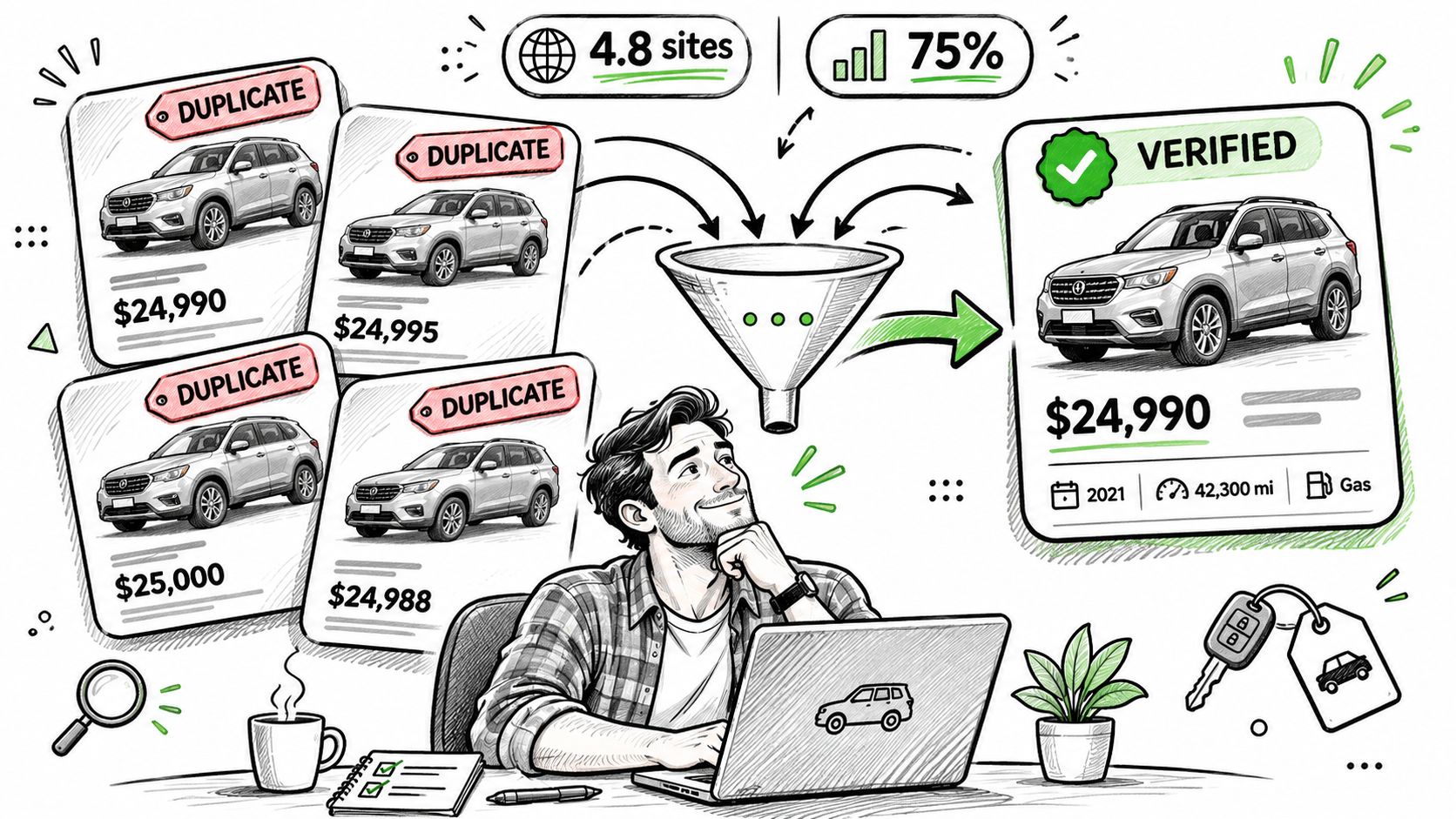
In its 2025 buyer-journey summary, Cox Automotive reports that 75% of buyers used third-party automotive websites and that used-vehicle shoppers visited an average of 4.8 sites (Cox Automotive 2025 Car Buyer Journey Study). Four or five sites is ordinary behavior, which makes seeing the same car four times ordinary too. A feed that treats each appearance as a separate opportunity triples your workload without adding a single vehicle, so the merge step is where broad coverage either pays off or buries you.
Match in Order of Reliability
VIN first. Then stock number, seller identity, mileage, price, and finally image similarity. A franchised dealer cross-posting to AutoTrader.com and Craigslist usually reuses the stock number, so that field alone resolves the pair. Private sellers repost with the same photos and a quieter price, which is why the image check catches what the price check misses. When two candidates tie on photos and mileage but differ on price, keep the cheaper copy as the lead record and log the higher ask as seller movement.
Keep the bookkeeping as you go. Timestamp the first sighting, preserve the original listing URL, and re-check any listing whose price, mileage, status or availability has changed. A car that dropped $1,500 in four days is a different opportunity from the one you opened on Monday.
Four pitfalls account for most of the wasted hours:
-
Treating duplicates as separate leads. Two rows, one car, one phone call.
-
Mixing CAD and USD in one column. A Canadian listing sorts as a bargain until you convert it.
-
Reading an asking price as market value. Sellers anchor high, and stale listings anchor highest of all.
-
Reading a missing deal score as a verdict. No comparable data means no score, not a bad car.
Broader coverage cuts search time and adds verification time. Neither is optional, and only one of them can be automated.
The merge-and-check rhythm is easier to watch than to describe.
Run a Two-Stage Review
Stage one is automated eligibility against the hard limits you already set. Year, mileage, transmission, maximum price, distance. Anything failing a hard limit leaves the queue without a second look.
Stage two is human verification, and no filter does it for you. Compare identical photos and descriptions across sources to spot copies, because the same three driveway shots on two listings three hours apart is a repost or a clone. Request the VIN before you travel and match it to the car in person. Verify title and odometer records independently of anything the seller sends you. Confirm the seller’s name matches the ownership documents.
Cloned listings on otherwise trusted platforms, fake escrow services, and wire or gift-card payment requests show up often enough that the vehicle purchase scam guide from HowScamsWork documents the pattern. A marketplace link and a “buyer protection” claim are not proof of legitimacy.
Flag any of the following before you commit to a trip:
-
A price far below comparable cars in the same city, mileage band and trim.
-
Mileage that contradicts the photos, such as a worn pedal pad on a 30,000-mile listing.
-
Stock photos or dealer watermarks on a listing advertised as private.
-
Pressure to pay a deposit remotely before inspection.
-
Refusal of an independent inspection, which ends the conversation politely.
Flipify Motors covers the first half of that workload. Each alert links straight to the original marketplace listing, and the review step puts vehicle details, available deal context and similar listings side by side, so you can open the source and contact the seller without rebuilding the search. A match becomes inventory after both stages, not after the notification.
Set Alerts for Speed Without Noise
The metric that matters is qualified-alert conversion: the share of alerts that survive validation and produce a seller contact, an inspection or a purchase. A hundred notifications that die in verification are worth less than six that turn into phone calls.
Speed only helps if the alert deserves a response. Coverage across six marketplaces means the same car can trigger several matches at once, and every duplicate burns the minutes you were trying to save. The search is the easy half; triage is the job.
Build three tiers from fastest to slowest
-
Instant tier. Exact matches on your saved searches pushed the moment they post, plus price reductions and anything priced below a local percentile you define in advance.
-
Daily digest. Near matches batched once a day, so good-but-not-perfect cars still reach you without interrupting the afternoon.
-
Weekly sweep. Broad keyword variants reviewed once a week to catch drift, retire noisy terms and decide whether a source deserves promotion to the instant tier.
The urgency benchmark is unforgiving. Audited companies averaged 42 hours to respond to online leads, and 23% never responded at all, according to lead-response research summarized in Osmosia’s analysis of lead-response delays. Aim for minutes on a high-confidence alert: open it, record the contact time, and send a standard first message that states your interest, asks for the VIN and requests a viewing window.
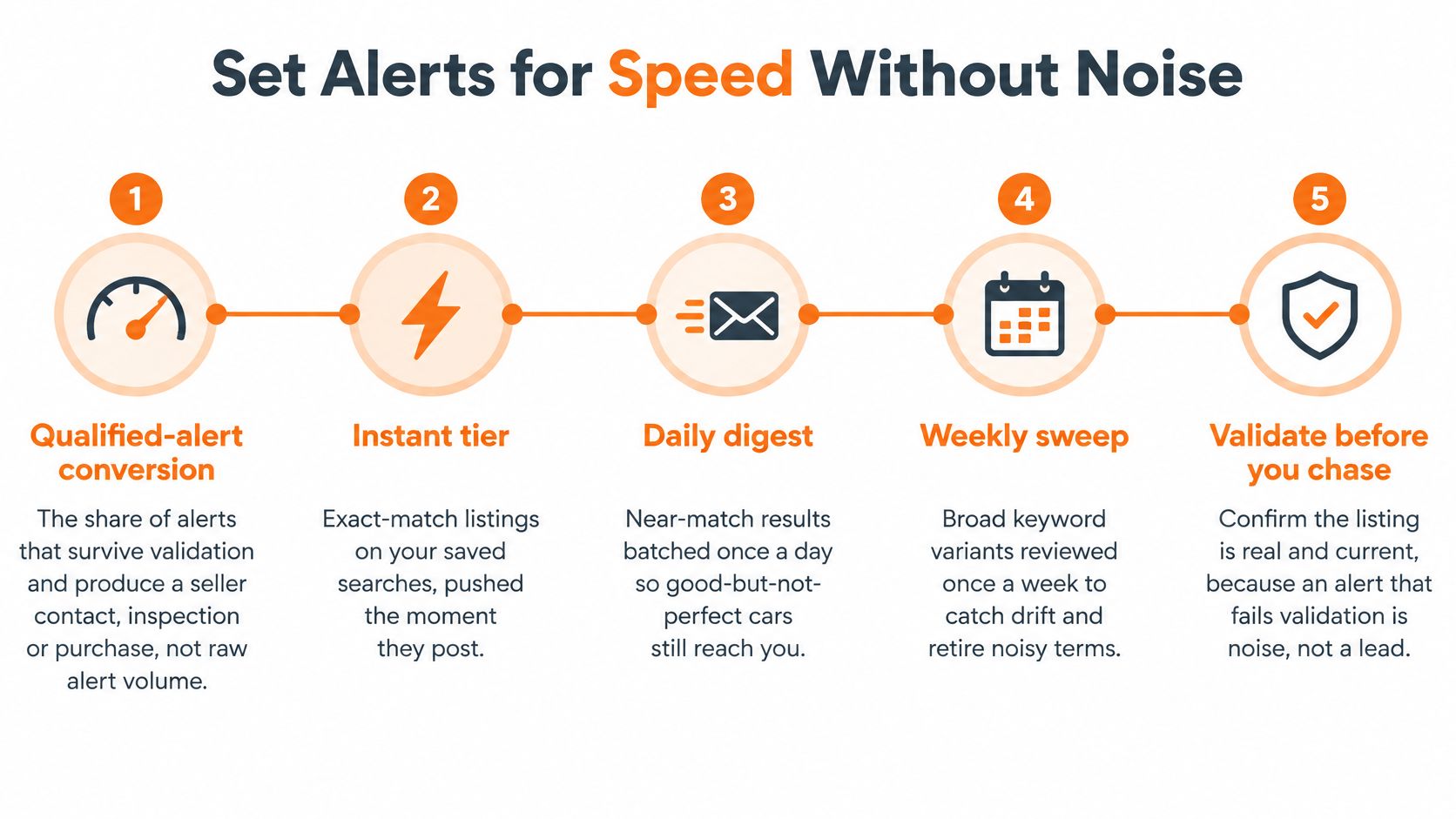
Practical rule: an alert that hasn’t been opened, verified and answered within the hour was entertainment, not inventory.
A notification earns its place only if it carries price, miles and distance, so you can judge it in seconds and message the seller while the car is still available. Then track what happens downstream: time-to-alert, time-to-contact, seller-response rate, inspection rate, purchase rate, gross spread, holding days and net profit after transport, taxes, platform or auction fees, repairs, detailing and financing. That chain of numbers tells you whether your tiers are sorted correctly; a daily digest car that keeps converting is a signal to tighten the instant tier, not a reason to check the digest more often.
Cheap listings in a feed often carry deceptive advertising, lemon vehicles, incomplete repairs and mechanical failures, so don’t optimize for the lowest asking price alone. If a Facebook alert keeps arriving late, the fixes in this guide to Facebook Marketplace car notifications are worth working through before you blame the marketplace.
Run a weekly cohort analysis by marketplace, model, seller type and price band. That shows which sources generate profitable matches rather than merely numerous ones, and which marketplaces you should switch off for a given search.
Compare Prices Across Markets Fairly
Market context decides what a price means. U.S. used-vehicle availability in February 2025 ran 4.2% higher year over year and 13.2% above February 2023, while the average used-vehicle list price fell 2.2% year over year to about $27,700, and demand still rose 1.4% year over year, per the CarGurus Intelligence Report for February 2025. Volume stayed strong through the summer, with 1.55 million used-retail sales in August 2025 according to Cox Automotive’s used-vehicle inventory report.
More supply and softer list prices do not mean the cheapest listing is the best buy. A raw asking price from another market isn’t a comparison, it’s a number. The cheapest car in a feed is often damaged, incomplete on history, or sitting where taxes, transport costs and local demand are different from yours.
Adjust before you judge
| Factor | Adjustment | Example |
|---|---|---|
| Mileage | Compare cars within a close mileage band | A 2020 CR-V at 48,000 miles against one at 62,000, not against the cheapest car in the state |
| Accident history | Compare clean-title cars only, or deduct the disclosed damage | A listing with a reported front-end repair needs a lower bar |
| Currency | Convert CAD and USD on the same day | A CAD 18,500 asking price is not USD 18,500, so run both through the same rate |
| Taxes and transport | Add a transport quote and local tax for each route | A car bought in Ontario carries 13% HST, so add the transport quote for the route |
| Trim and options | Match trim level and major options | An LX and an EX are not comparable on price |
| Time on market | Note days listed and any price changes | A car listed 45 days with two price cuts has room; one listed two days usually doesn’t |
For a dealer or a flipper, the useful number is the expected resale spread after acquisition, transport, repairs, platform fees and holding time. A $1,200-cheaper car three states away that costs $900 to move and six extra weeks to sell is not cheaper. Work the spread first, then argue about the sticker.
An asking price is a seller’s opening position. Value is what the car actually sells for in your market, after your costs.
Comparable listings give you a range with confidence limits, not a valuation. Three comparable cars within 30 miles tell you something; one comparable car in another province tells you almost nothing. When the comparison is thin, treat the number as a question to answer at inspection, and read up on how to tell if a used car is a good deal before you negotiate on a single data point.
Start Your First Cross-Market Search Today
Seven days is enough to find out whether your search is working.
-
Day one. Pick two or three marketplaces that cover your area, then build one watchlist from the criteria table. In Flipify Motors you switch on the marketplaces you want for each search, and new listings from all of them arrive in the same alerts.
-
Days two to four. Let the watchlist run. Deduplicate what arrives, and record the first-seen timestamp and original URL for every listing you keep.
-
Days five and six. Apply the price adjustments to the listings that pass eligibility, then run the verification checklist on the best two or three. VIN before you travel, title and odometer checked independently.
-
Day seven. Review the numbers: how many alerts became seller contacts, and how fast you responded. Tighten the filters that produced noise, and add a source only if the existing feeds produced real matches you couldn’t act on.
Saved searches can be kept as watchlists for different vehicles or areas, with new matches appearing together in one focused feed, which is what makes a seven-day test realistic rather than aspirational.
Then set one measurable target: convert at least 1 in 5 alerts into a seller contact within 30 days, and track the rate weekly. If you’re below that, the problem is almost always a filter that’s too loose, a response that’s too slow, or a source that belongs switched off.
Flipify Motors watches six marketplaces, including Facebook Marketplace, AutoTrader.ca, AutoTrader.com, Craigslist, OfferUp and eBay Motors, and pushes new matches into one feed so the discovery half of this workflow stops eating your evenings. Switch sources on or off per search, keep a separate watchlist for each strategy, and open the original listing with one tap when an alert looks right. Visit Flipify Motors to start the seven-day free trial and put your first cross-market search to work this week.