
10 Best Car Search Apps for Buyers and Resellers in 2026
Compare the best car search app options of 2026 by marketplace coverage, alerts, price context, and resale tools to find the right fit for your next deal.

You’ve got Facebook Marketplace open in one tab, Craigslist in another, and eBay Motors in a third. A wagon priced well under everything comparable just appeared, so you message the seller and keep refreshing, because you already know how this ends. Twelve minutes later the reply lands: sold, someone else got there first.
The problem a car search app solves isn’t “finding cars.” It’s finding the right one before another buyer does, then working out whether the asking price is good. No single app does both well for every kind of buyer.
Some apps watch several marketplaces at once. Some search only one dealer network but add real price context. Others serve niche channels such as auctions, Canadian inventory, or online-only retail. The useful distinction between them isn’t inventory volume. It’s which one matches the way you buy or flip.
So the ten below are grouped by workflow rather than ranked: cross-marketplace monitoring, price context, dealer inventory, and niche or retail channels. Judge each on marketplace coverage, filter depth, alert speed, price context, and whether it supports a resale workflow.
1. Flipify Motors
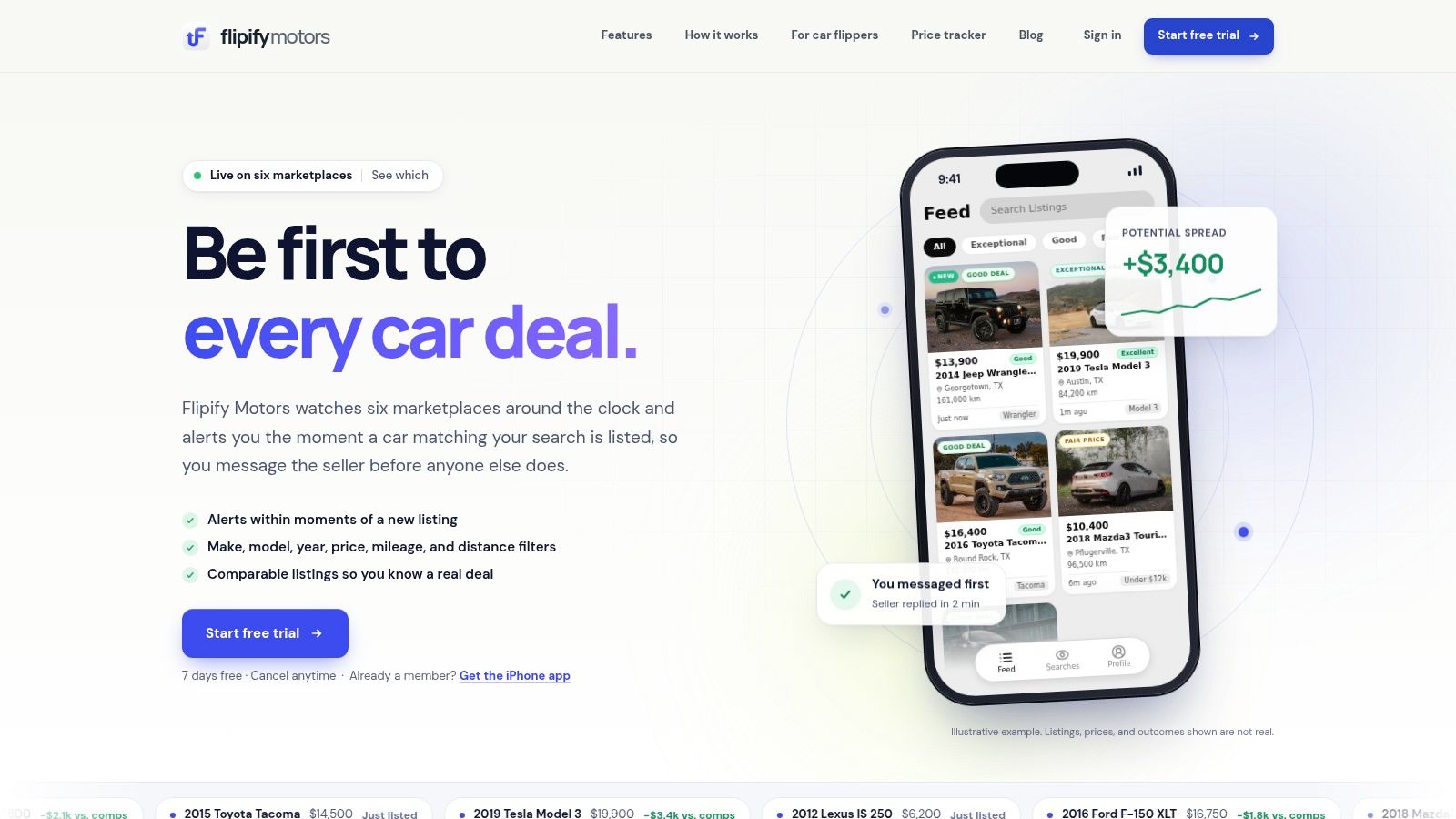
Monitoring several marketplaces at once is the workflow that saves the most time, and this app is built specifically for it. Flipify Motors watches Facebook Marketplace, AutoTrader.ca, AutoTrader.com, Craigslist, OfferUp, and eBay Motors, then pushes matching listings into one feed instead of six.
The time case is straightforward. Cox Automotive’s 2024 Car Buyer Journey Study found that used-vehicle buyers who used the internet while shopping spent an average of 7 hours and 29 minutes researching and shopping online, more than the 2 hours 51 minutes they spent visiting other dealerships or sellers. Run that research across six sites with six sets of filters and the number compounds.
How the monitoring workflow runs
Build a watchlist with make, model, keywords, location, distance, price, year, mileage, and transmission. The service scans continuously and sends push alerts carrying price, mileage, distance, and a link to the original listing so you can contact the seller directly. Separate watchlists let you hold a narrow personal search beside a broad inventory search without one polluting the other.
Practical rule: Keep one tight watchlist for the exact car you want and one loose watchlist for anything in your price band that moves fast. The tight one keeps you honest about condition and spec, and the loose one surfaces the mispriced trade-in the seller didn’t research.
Price context sits next to the listing: comparable listings, deal scores where available, and a price tracker showing typical asking prices for popular used vehicles. For resale work, purchase cost, sale status, proceeds, and estimated profit stay in the same record instead of a spreadsheet you forget to update. It runs on the web and iPhone, with Android described as coming soon, and the site advertises a seven-day free trial with cancellation at any time.
- Coverage: six marketplaces, US and Canadian, combined into one feed.
- Speed: continuous scanning rather than a once-a-day email digest.
- Resale tools: purchase cost through estimated profit in a single place.
- Honest limit: comparable listings and deal scores aren’t guaranteed on every vehicle, and the spread examples on the website are illustrative, not promised savings.
Pricing isn’t displayed on the site, so the trial is the way to judge it against the hours you’d otherwise spend refreshing tabs. Start at flipifymotors.com, and for the watchlist method in more detail, read the best app for finding cars.
2. AutoTempest
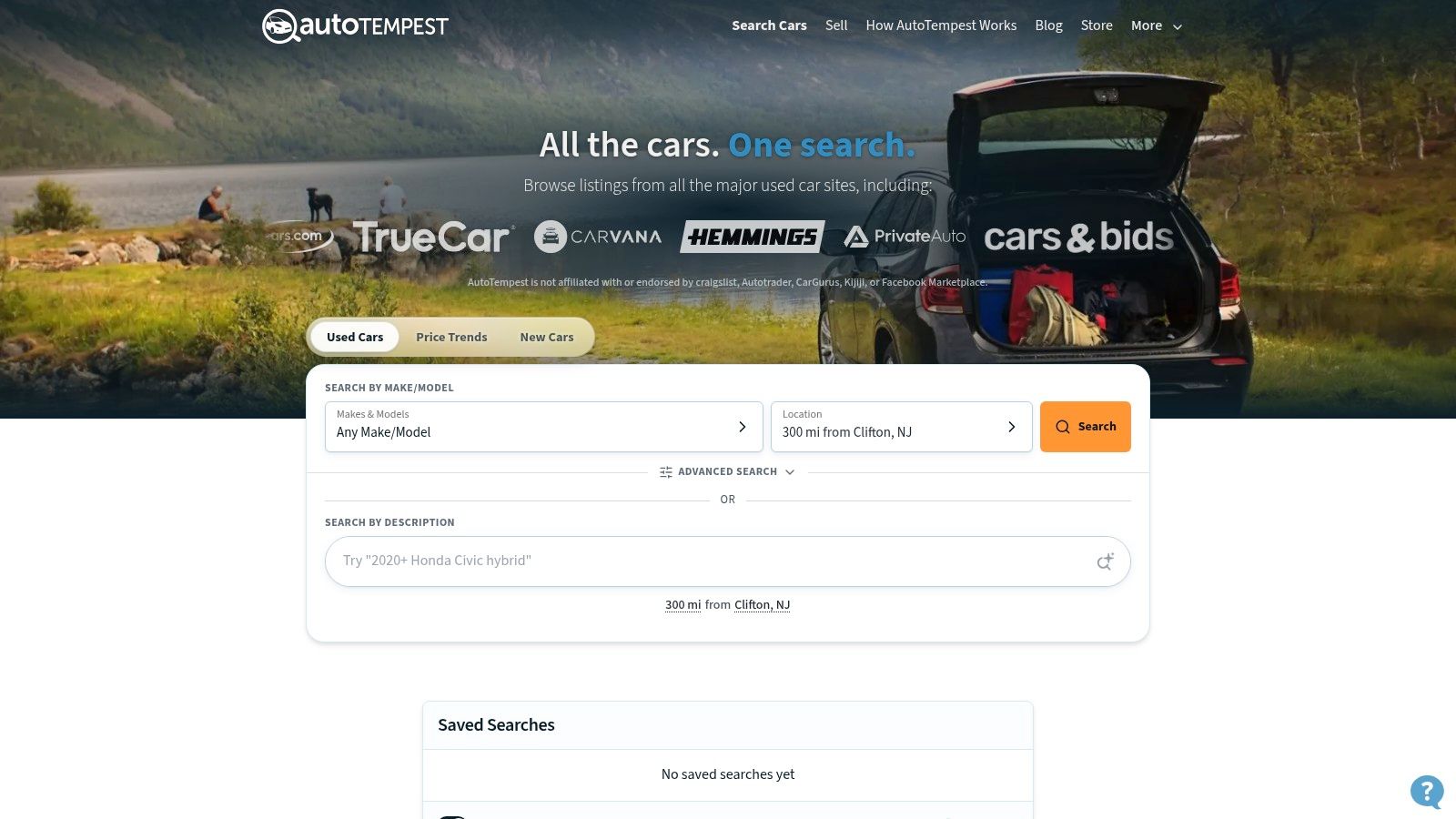
AutoTempest answers one question faster than anything else on this list: how many of these exist within a day’s drive? It gathers or links to listings from sources including Cars.com, eBay Motors, Carvana, Hemmings, and Cars & Bids, which means a search for a plain used sedan and a search for a 1990s Japanese coupe both work.
It’s free, runs on the web plus iOS and Android, and covers both the US and Canada. For unusual models where local inventory is thin, widening the radius is usually the only real option, and this is the quickest way to see what that radius contains.
The limits are structural, not cosmetic. Some results appear as comparison links rather than inline listings, so the seller details and contact step happen on another site entirely. Saved-search management is thinner in the mobile app than on the web, which matters if you’re managing a dozen searches on a phone.
An aggregator narrows the field. It doesn’t vet anything. Every result you open is still the seller’s claim about their own car.
That distinction is why a broad search never finishes the job. In a 2025 survey of 3,030 recent vehicle buyers and sellers, 83% said they preferred doing more shopping from home, yet 86% still wanted to see the vehicle in person before buying, per the CarGurus study reported by The Globe and Mail. AutoTempest is the shopping-from-home half. The inspection is still yours to arrange.
Use it as a coverage check rather than a daily driver. For combining marketplace searches into one running workflow instead of a one-off query, see how to search all marketplaces at once.
3. CarGurus
Deal Ratings are the reason to open CarGurus, and the reason to read it carefully. Listings get compared against estimated market values for similar vehicles, which turns an endless grid of asking prices into something closer to a shortlist. Saved searches, price-change alerts, and side-by-side comparison of saved vehicles fill out the rest of the workflow.
It covers new, used, and certified pre-owned inventory, with free search on the website and app. If you’re shopping a common model with dozens of near-identical examples, that triage is very useful. You can rank by how far each price sits from the local norm and stop reading the rest.
Three limits matter. The marketplace leans dealer rather than private-party, not every listing earns a rating, and a rating tells you how the asking price compares to similar listings, not whether the car is sound or whether mandatory fees are baked into the number you see.
That last gap is where most buyers lose money. A 2025 report cited by MarketWatch found that 71% of surveyed used-car buyers experienced bait-and-switch tactics including unexpected or excessive fees, with those fees averaging $640. The FTC has also warned that advertised vehicle prices must include mandatory fees, which makes this an active regulatory concern rather than a gripe.
Where this falls apart: a deal rating compares asking prices. It can’t tell you what the out-the-door number will be after doc fees, add-ons, and financing.
Treat CarGurus as step one and ask for a written out-the-door quote before step two. See cargurus.com.
4. Autotrader
Autotrader is what I’d open when I want dealer inventory and private-party listings inside the same search. That mix is rarer than it sounds, and it matters if you’re sourcing cars to resell, because private sellers are where the margin usually lives.
Filters are detailed and accept keywords, so you can search a trim name or a package code instead of guessing from photos. A free My Autotrader account saves up to 50 searches and 50 cars, and alerts can be set by email or text, including new-match and price-drop notifications inside the app.
What to expect from the alerts
Alerts are the weak point in the chain. They may arrive daily or weekly rather than the moment a car is listed, which is fine for a two-week shopping project and fatal for a underpriced private-party car that sells in an afternoon. Listings also lag reality, so a vehicle can be gone before the page updates.
Use it for structured discovery and follow up by phone the same day. Search is confined to Autotrader’s own marketplace, so it won’t show you the Facebook listing that’s $2,000 cheaper. Website is autotrader.com.
5. Cars.com
Cars.com bundles two jobs that usually live in separate browser tabs: inventory search and dealer research. Filters cover price, mileage, year, features, fuel type, and body style, and saved cars can trigger price-drop alerts, with a free account syncing your shortlist between the app and the website.
The dealer reviews and research content are the differentiator. When you’re deciding between three similar SUVs at three dealerships, having reviews and payment estimates in the same screen saves a step. Photo search in the mobile app is a small feature that helps more than expected when you’re hunting a specific wheel or interior.
Two habits keep it useful. Confirm price and availability with the seller directly, because the listing may not reflect the current sticker. And ignore the estimated monthly payment as a decision tool. On a flip, the monthly figure hides fees, term length, and interest, none of which belong in your cost basis.
Search covers Cars.com’s own marketplace rather than all classifieds, so it’s a dealer-inventory tool, not a monitoring layer. It’s free on iOS and Android, with some features requiring an account. See cars.com.
6. Edmunds
Edmunds is a research service that happens to carry listings, and that order of priorities is the point. True Market Value pricing and ownership-cost tools give you a second opinion on what a model trades for in your area, which is exactly the context a bare listing feed leaves out.
The app supports local new and used inventory searches with price and mileage filters, saves both searches and individual listings, and holds specifications, safety information, and expert plus owner reviews. If you’re deciding whether a hybrid premium pays back over four years, the ownership-cost tools answer that faster than a forum thread.
Its limits are predictable. Listings lean dealer, valuations are estimates rather than guaranteed transaction prices, and it’s not a cross-marketplace alert service, so nothing here will notify you the second a private seller posts. That’s fine. Research and monitoring are different jobs.
The practical use is triangulation. When a dealer quotes a number, check it against TMV, then against three comparable listings, then against your own recon estimate. If all four agree, you’re probably paying market. If only the dealer’s number is high, you already know what to negotiate. See edmunds.com.
7. CARFAX Used Car Listings
CARFAX earns a place on this list for screening, not for inventory breadth. Used listings include a free CARFAX Report where available, and the app tracks saved cars, new listings, price drops, and even sold vehicles, which is more useful than it first appears. Watching a car sell tells you what the market paid versus what sellers are asking.
That screening matters because the fraud risk in online car buying is real. The Better Business Bureau reported more than 200 cases since 2022 involving consumers trying to buy vehicles or heavy equipment online from scammers impersonating reputable sellers, with warning signs including unusually low prices, refusal to permit an in-person inspection, pressure toward third-party payment channels, and requests for delivery rather than pickup.
A clean report means nothing was reported, which is not the same statement as nothing happened.
That’s the correct reading of any history report. Incidents go unrecorded when a car is repaired privately or the damage never reaches an insurer, so a report is a screening filter and a mechanical inspection is the decision. Listings skew toward participating dealers, and private-party inventory is thin.
Run the report, note the ownership pattern and any gap in service records, then book the pre-purchase inspection. For how these reports compare against the alternatives before you spend on one, read CARFAX versus AutoCheck for flippers. Website is carfax.com.
8. AutoTrader.ca
If your search area crosses into Canada, this is the inventory source that matters. AutoTrader.ca covers Canadian new and used inventory with filters for make, model, trim, year, price, mileage in kilometres, transmission, fuel type, and location, and it lists both dealer and private-seller cars depending on the market.
Saved searches with email or app notifications do the ongoing work, which is the only sane way to watch a market you don’t live in. The mile-to-kilometre conversion is the small detail people get wrong. A 150,000 km car has roughly 93,000 miles on it, and a “$9,000” asking price is in Canadian dollars, so your landed cost includes the exchange rate, import paperwork, and any provincial inspection.
The tool itself is Canada-only by design, so it’s useless for a US-only search, and it doesn’t merge results from unrelated marketplaces. Listings also change and sell without notice. Search it directly at autotrader.ca.
9. eBay Motors
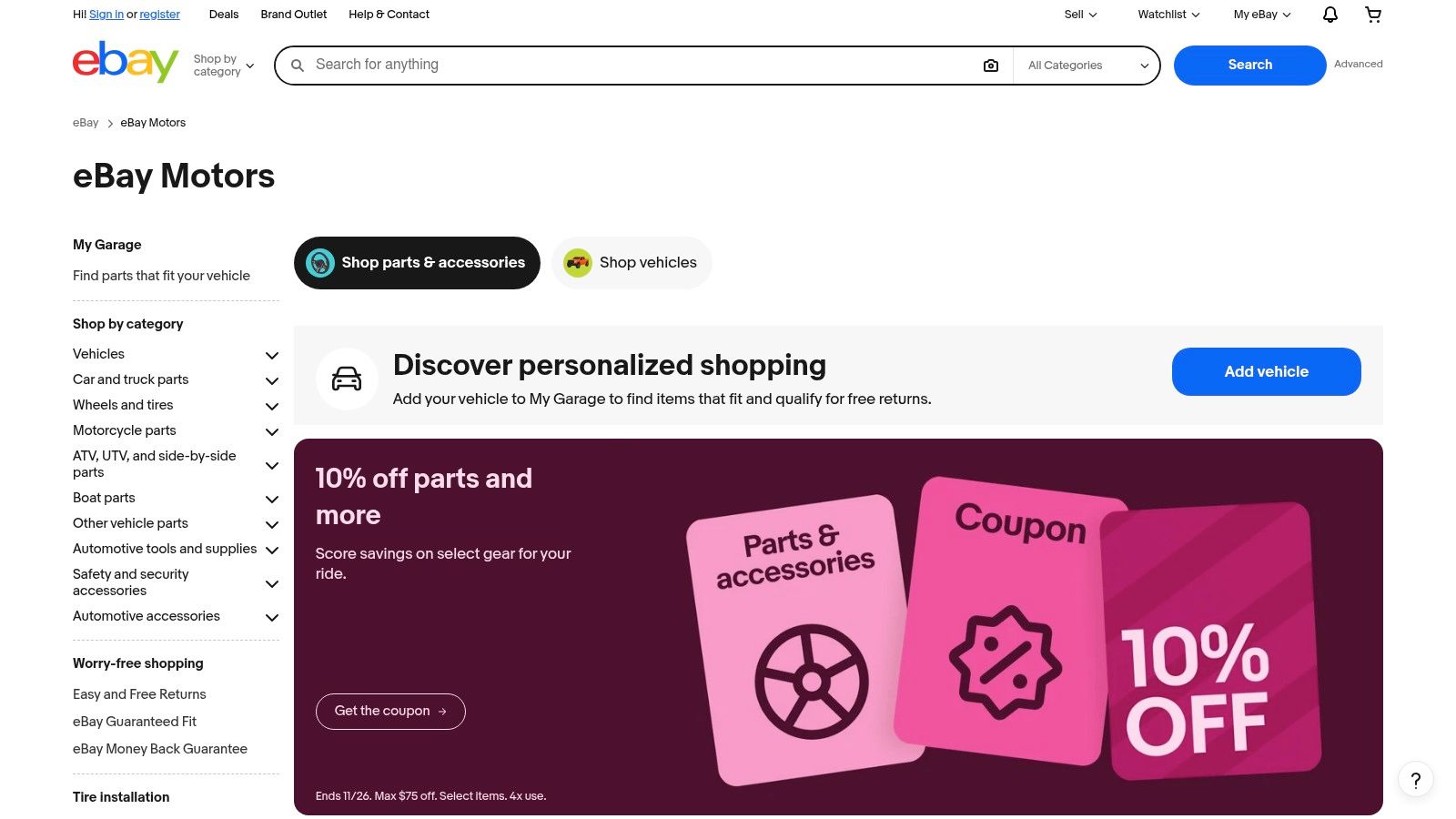
Some cars don’t exist within 300 miles of you, and eBay Motors is where they surface. Searches filter by make, model, year, trim, transmission, and location, and depending on the listing you can bid, use Buy It Now, or make an offer.
The national reach is the whole value. Project cars, imported models, and enthusiast vehicles that never appear in local classifieds show up here, and the same app covers the parts and accessories you’ll need to finish the job, which matters more than the search itself on a restoration.
Risk management is the skill. Online and auction purchases demand careful reading of payment terms, pickup or shipping arrangements, and what happens if the car isn’t as described. Listing quality varies enormously, and buyer protections differ by listing type.
Before an auction ends, ask for a cold-start video, underbody photos, and close-ups of the common rust points for that model, then line up an inspection if the car is local enough. Where it isn’t, price in a flight or a prepurchase inspection service before you bid. See ebay.com/motors.
10. Carvana
Carvana is a retailer, not a marketplace, and it’s worth judging on those terms. You search one company’s catalog by make, model, budget, and mileage, then complete much of the purchase online, with financing prequalification, trade-in tools, and delivery or pickup depending on your location.
That model suits a specific buyer: someone who wants a fixed price, a short process, and no negotiation. Cox Automotive’s 2024 Digitization of Automotive Retail study, which surveyed 2,193 consumers, found that 43% of shoppers said they would conduct some or most of the purchase process online, and that buyers who completed key steps online saved an average of 42 minutes at the dealership. Carvana compresses those steps into one session.
The trade-off is coverage and price discovery. Inventory is limited to what Carvana owns, availability depends on your location, and fixed pricing removes the negotiation that sometimes produces a better deal on a comparable car sitting 20 miles away. Online completion also isn’t a substitute for a history review or an independent inspection where one is possible.
The sensible workflow is to price Carvana against three local comparable listings before committing. If the convenience premium is small, take it. If it’s large, negotiate elsewhere. See carvana.com.
Car search apps compared
| Marketplace coverage | Saved searches and alerts | Price context tools | Resale / workflow features | Platforms |
|---|---|---|---|---|
| Flipify Motors, Facebook Marketplace, AutoTrader.ca, AutoTrader.com, Craigslist, OfferUp, and eBay Motors | Custom watchlists and continuous push alerts | Comparable listings, available deal scores, and typical-price ranges | Track purchase costs, sale status, proceeds, and estimated profit | Web and iPhone; Android coming soon |
| AutoTempest, multiple sources, including Cars.com, eBay Motors, Carvana, Hemmings, and Cars & Bids; U.S. and Canada | Search criteria; saved-search management may be limited in the mobile app | Compare listings across sources | Links to listings on other sites | Web, iOS, and Android |
| CarGurus, primarily dealer listings | Saved searches and alerts for new matches or price changes | Deal Ratings and estimated market-value comparisons on eligible listings | Compare saved vehicles side by side | Website and mobile app |
| Autotrader (U.S.), dealer and private-seller listings | Save up to 50 searches and cars; email or text alerts | Price-drop notifications | Save and compare vehicles | Website and app |
| Cars.com, its own marketplace | Save searches and cars; price-drop alerts | Estimated monthly payments | Dealer reviews and saved-item syncing with an account | Website, iOS, and Android |
| Edmunds, largely dealer-oriented local inventory | Save searches and listings | True Market Value and ownership-cost tools | Vehicle research, specifications, and reviews | Website and mobile app |
| CARFAX Used Car Listings, participating dealer inventory | Track saved cars; alerts for new listings, price drops, and sold vehicles | Price-drop alerts | CARFAX Reports where available; dealer ratings and reviews | Website and app |
| AutoTrader.ca, Canadian dealer and private-seller listings, depending on market | Save searches; email or app notifications for matches and price drops | Price-drop notifications | Search and compare Canadian inventory | Website and app |
| eBay Motors, national vehicle listings, including enthusiast and collector cars | Save searches and watch listings | Listing prices and bidding provide purchase context | Bid, Buy It Now, or make an offer where available | Website and app |
| Carvana, Carvana’s own used-car inventory | Search filters; saved-search alerts not specified | Vehicle prices and estimated payments | Online purchase, financing, delivery or pickup, and trade-in tools | Website and app |
Matching the App to Your Buying Workflow
The app you keep depends on how you buy, not on which one has the biggest inventory count. Match the workflow first, then the tool.
Chasing fast private-party deals
Speed decides these. You want cross-marketplace monitoring with push alerts, because the money is in the twelve minutes between a listing going live and the seller’s phone filling up. Dealer-network apps with daily or weekly digests lose this race consistently, no matter how good their filters are.
Stacking rule: one monitoring app for alerts, one research app for pricing. Monitoring tells you a car exists. Research tells you whether the number is good.
Shopping dealer inventory
Lean on price context. Deal Ratings on CarGurus and True Market Value on Edmunds both answer the same question from different angles: is this asking price normal for this car, in this market, this month? Neither establishes condition, and neither includes the fees you’ll see in the finance office. Get the out-the-door number in writing before you compare anything.
Collectors and enthusiasts
Reach beats proximity. eBay Motors and AutoTempest both surface cars that don’t exist locally, and both push the work to you: verifying condition, arranging inspection, and pricing transport. Budget for the logistics before you bid, not after.
Resellers and small dealers
Search is only half the job. The other half is knowing what you paid, what you’ve spent on recon, what sold, and what’s still sitting. Tracking that in your head works until about the fourth car. Keep purchase cost, sale price, and estimated profit in the same place as the search, and let a price tracker tell you where the model sits before you make an offer.
The limit every app shares
Every tool here speeds up discovery. None of them replaces an inspection, a VIN check, or a conversation with the seller. Fraud warnings cluster around the same signals, an implausible price, a refusal to allow inspection, a push toward wire transfers or gift cards, and no app can screen those out for you. The best any search tool does is buy you time to ask better questions.
If refreshing six marketplaces in separate tabs is your current process, Flipify Motors replaces it with saved watchlists across Facebook Marketplace, AutoTrader.ca, AutoTrader.com, Craigslist, OfferUp, and eBay Motors, plus push alerts that carry the price, mileage, distance, and a link to contact the seller. You can hold separate watchlists for a personal search and a resale search, compare comparable listings and available deal scores, and track purchase cost through estimated profit for anything you flip. Visit Flipify Motors to start a seven-day free trial and see how many matching cars your usual searches were missing.