
Cheap Car Sales Near Me: A Local Buying Guide
Find cheap car sales near me, set a real budget, compare local prices, and check the seller and the car before you pay.

You’ve found a cheap sedan close to home, the photos look decent, and the seller says it runs well. There’s also a more expensive compact nearby, but spending more feels wrong when you’re trying to keep cash in your account.
That’s the trap behind many searches for cheap car sales near me. The lowest asking price can leave you with the highest transportation bill once interest, overdue maintenance, insurance, and repairs are included. Start with what you can afford to own, then decide which nearby cars deserve a message.
What a Cheap Local Car Really Costs
Say the sedan has worn tires, no service records, and a loan offer with an expensive rate. The compact costs more upfront but has documented maintenance and no immediate work identified. Neither is automatically the better purchase, but the sedan’s sticker discount isn’t enough to decide.
Cheap should mean affordable to own, not merely affordable to collect. Choose a fixed ownership period for your comparison, then build the same budget for every candidate. Don’t compare a cash purchase price with a financed monthly payment, or a freshly serviced car with one whose repair needs remain unknown.
Build the budget before choosing the car
Use these six lines:
- Asking price. Start with the advertised amount, then request the seller’s actual sale terms. For dealer inventory, ask for an itemized out-the-door quote.
- Tax and registration. Use the rules and fees for where you’ll register the vehicle, not the seller’s location alone.
- Insurance. Get a quote using the actual VIN and the coverage you’ll need, including any lender requirements.
- Fuel. Estimate your normal driving, not the seller’s description of economical commuting.
- Repair reserve. Separate known work from money held for unexpected failures. Neither belongs in your down payment.
- Financing. Compare APR, term, amount financed, and total repayment, rather than payment alone.
The age and mileage attached to a budget price deserve particular attention. The Edmunds used-car report reports that vehicles sold for $10,000–$15,000 in Q2 2026 averaged 8.7 years old and 98,222 miles, versus 4.7 years and 58,250 miles in Q2 2019, and cites an average used-car loan rate of 19% for borrowers with credit scores of 501–600 in Q3 2025.
Those are separate measures, not a loan quote for every car in that price band. They do show why you should examine mechanical condition and financing together.
Local price bands and what cheap usually means
| Asking-price band | Age and mileage | Money pressure | What to budget besides price |
|---|---|---|---|
| Vehicles below the mainstream used-car market | Expect older, higher-mile candidates; inspect each car individually | Limited choices can tempt buyers to accept neglected maintenance | Repair reserve, tax, insurance, and fuel |
| Budget-band vehicles in the newer Edmunds comparison | Older and higher-mile on average than the historical comparison | Borrowing costs can undermine an apparent discount | Monthly payment plus identified maintenance |
| The same band in the historical comparison | Younger and lower-mile on average | A historical benchmark, not a promise of today’s condition | The additional maintenance exposure of the actual candidate |
| Near the US used average | June 2025 average listing price $25,512, according to MarketWatch citing Cox Automotive | A broad market marker, not a cheap-car target | Use it for context, not as permission to stretch |
At Flipify Motors, our Honda Civic price tracker shows a typical asking price of $4,699, with most listings ranging from $2,800 to $8,950, across 13,631 listings. That spread is a reason to investigate individual cars, not assume the cheapest Civic is underpriced.
Budget rule: Keep repair money outside the amount you’re willing to hand the seller.
Write an ownership ceiling and an acquisition ceiling before opening a marketplace. The first protects your household budget; the second tells you which ads you can realistically pursue.
How to Search Cheap Car Sales Near You
Search with a repeatable process rather than browsing whatever appears first. A household buyer and a small dealer can use the same filters, although the dealer also needs room for resale costs and profit.
Use this workflow to move from a broad search to a manageable shortlist.
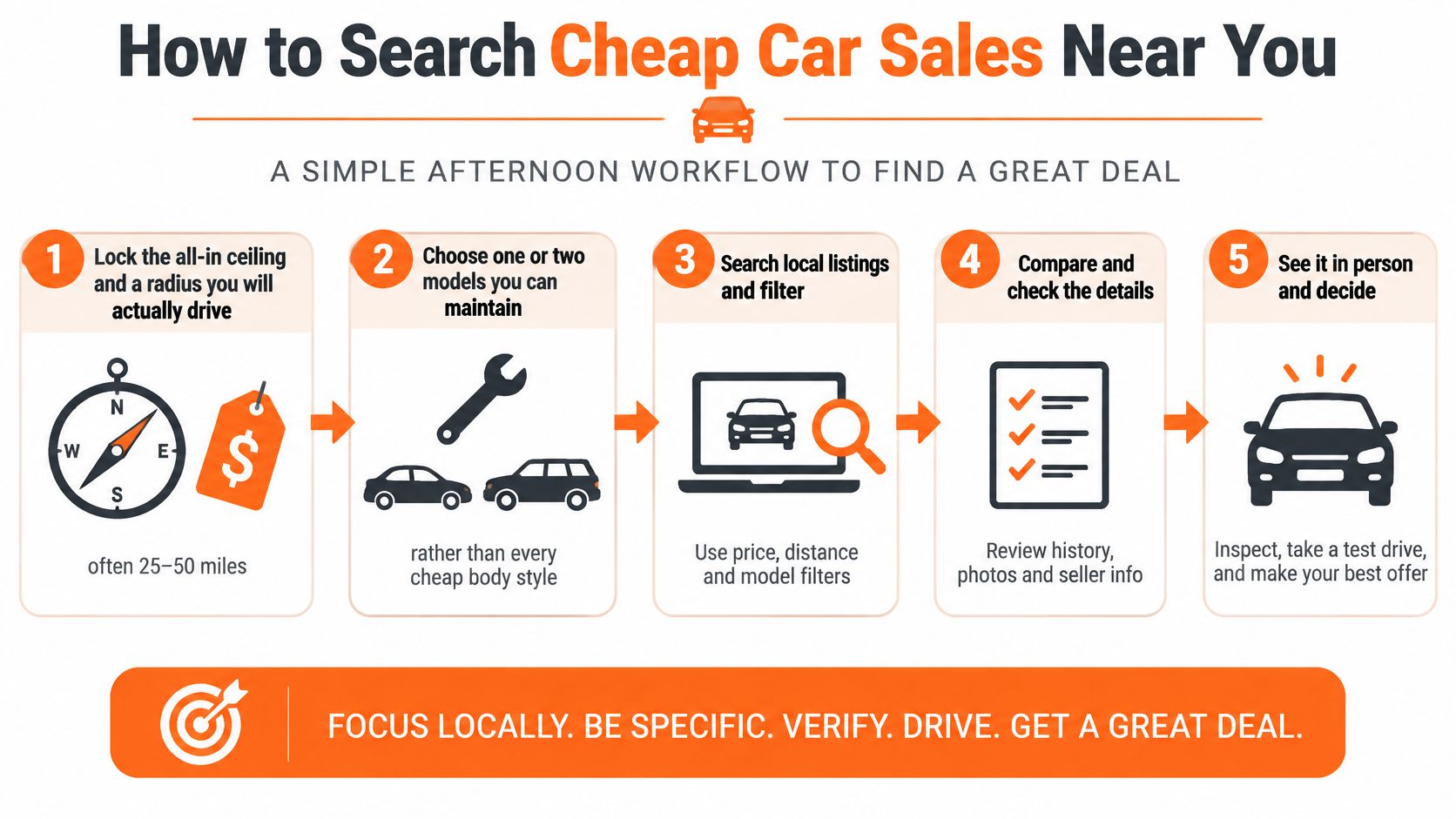
Set up a search you can act on
-
Lock the spending limit and travel area. Choose a radius you’ll drive for a viewing and, potentially, another visit to collect the car. Include transport in your acquisition budget if you can’t bring it home yourself.
-
Choose models you can maintain. Look at parts availability, access to a suitable mechanic, and the maintenance requirements of the particular engine and transmission. A familiar badge doesn’t make every version equally suitable.
-
Apply useful filters. Set price, year, mileage, transmission, drivetrain, distance, and title status where available. Treat missing information as a question to resolve, not an automatic pass.
-
Save separate watchlists. Keep different models and areas separate so you can identify which search produces useful matches. Our watchlists accept make, model, year, price, mileage, transmission, and how far you’ll drive.
Where nearby cheap cars are listed
- Search across the relevant marketplaces. We watch Facebook Marketplace, AutoTrader.ca, AutoTrader.com, Craigslist, OfferUp, and eBay Motors. Our guide to searching across marketplaces explains how to organize that broader search without repeatedly entering the same criteria.
| Marketplace | Where it covers | Best use for a cheap local car |
|---|---|---|
| Facebook Marketplace | Worldwide | Nearby private-party listings and direct seller contact |
| Craigslist | United States and Canada | Local private ads, including older budget cars |
| OfferUp | United States | Nearby private sellers you can arrange to meet |
| AutoTrader.com | United States | Dealer and private inventory with more complete ads |
| AutoTrader.ca | Canada | Canadian listings filtered to your area |
| eBay Motors | United States | Additional inventory, with distance and shipping checked carefully |
-
Enable alerts, then screen the match. Our push notifications show price, miles, and distance, and a tap opens the source listing. That matters in a tighter budget segment: Cox Automotive reported 31–38 days of supply for vehicles below $15,000, versus approximately 42–49 days for all used vehicles.
-
Compare before contacting. Pull a small set of closely matched listings rather than accepting the app’s sort order as a value ranking. For resale, calculate maximum offer = expected resale value minus repair reserve, taxes and fees, transport, and target margin; for personal use, replace resale expectations with your acquisition ceiling.
Don’t over-filter on cosmetic preferences while leaving mechanical questions unresolved. Color and trim can narrow an already limited search without improving your ability to get to work.
This video provides another format for reviewing the buying process.
Keep a brief note beside each shortlisted car: why it fits, what information is missing, and what would disqualify it. You’ll send better questions and avoid repeatedly reconsidering cars that never met your requirements.
How Local Asking Prices Compare
A car below the national average isn’t necessarily a bargain. National figures describe the market’s scale; nearby comparable listings help you judge the car you might buy.
The ElectroIQ used-car statistics compilation reports approximately 40 million used vehicles sold in the United States in 2023, alongside an average used-car price of roughly $27,000 and an average new-car price above $47,000. That explains the appeal of used inventory, but it doesn’t establish fair value for an older local compact.
Use the broader market as context, then narrow the comparison to similar cars.
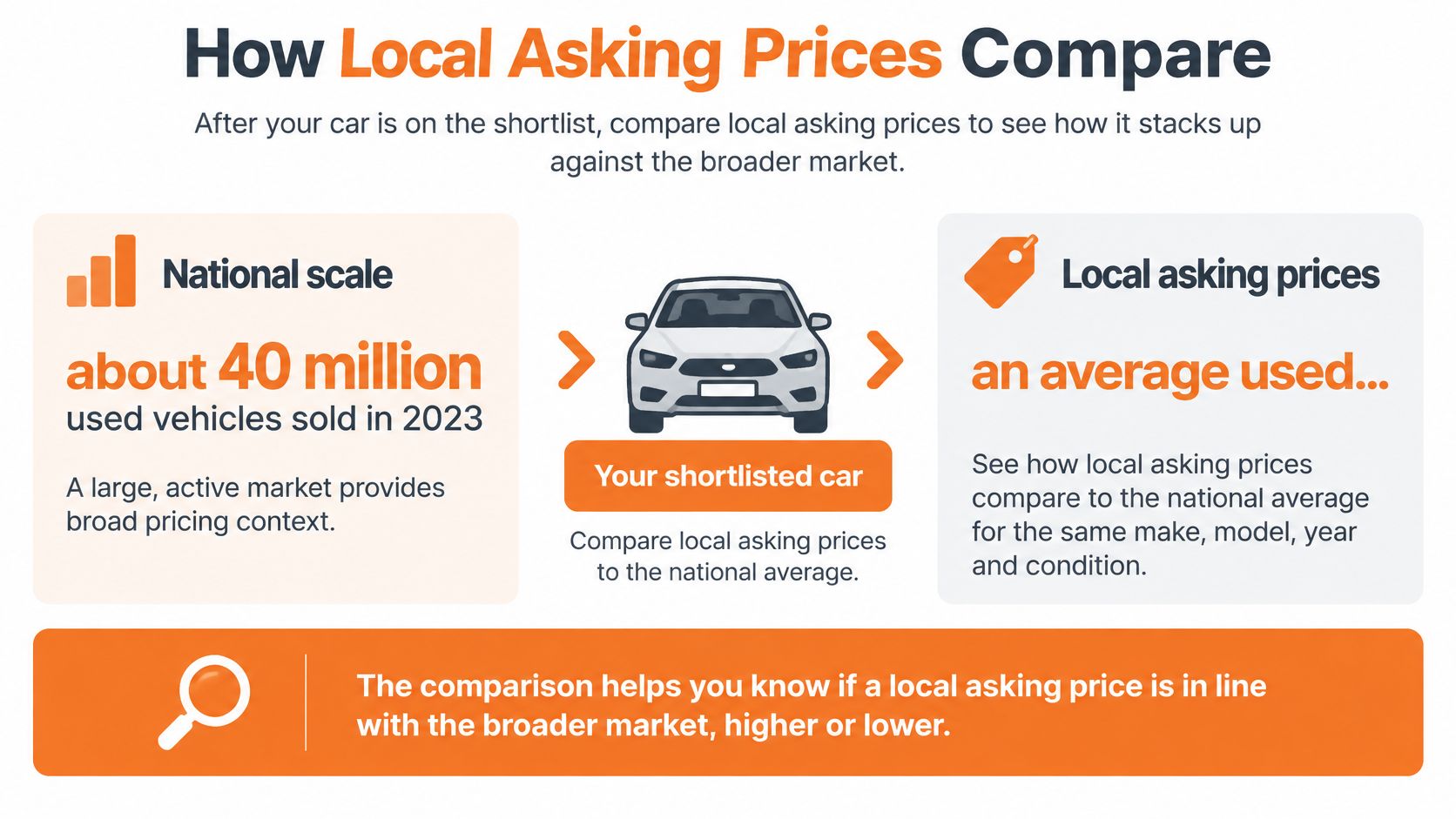
Compare like with like
Start with model year or generation, engine, transmission, mileage, and title status. Then separate dealer listings from private sales where fees, preparation, or sale terms differ.
Condition needs its own adjustment. A car with documented recent tires and brakes isn’t identical to one that needs both, even when the odometers are similar. Equally, a seller’s claim of recent work carries little weight without invoices or an inspection that supports it.
| Comparison factor | Useful match | Misleading match |
|---|---|---|
| Mileage | Similar mileage with service records considered | Comparing only by model name |
| Title | Matching title status and ownership documentation | Treating branded and clean-title cars as interchangeable |
| Mechanical condition | Known repairs included in the calculation | Assuming every car described as running needs nothing |
| Sale terms | Actual purchase cost and disclosed fees | Comparing a dealer headline price with a private cash price |
| Location | Cars you could realistically inspect and collect | A distant cheap listing with unpriced transport |
Our price tracker uses real marketplace listings to show typical asking prices, and our comparable-listing tools provide context for individual ads. An asking price is still an asking price, not proof that a buyer paid it.
Make the decision before arranging the drive
Consider a hypothetical Civic with high mileage and a low advertised price. If similar nearby Civics already sit at that level, the seller hasn’t offered an unusual discount. A more expensive example with lower mileage and stronger service documentation may be the better ownership choice, but only after its condition supports the premium.
Don’t assign value to mileage alone. A neglected lower-mile car can require more work than a properly maintained higher-mile example, and an invoice for recent repairs doesn’t guarantee the rest of the vehicle is sound.
A bargain needs a reason you can verify. A low number by itself isn’t that reason.
Use our guide to telling whether a used car is a good deal to keep the assessment focused on the vehicle rather than the excitement of finding it.
Finish with a clear call: pursue, negotiate, or skip. Pursue when the asking price and available evidence fit; negotiate when a specific, priced issue explains your lower offer; skip when the seller’s price requires optimistic assumptions.
How to Check the Seller and the Car
Once a listing survives the price comparison, verify that the seller can sell it and that the vehicle matches the ad. A convincing description doesn’t establish ownership, and a clean-looking engine bay doesn’t establish mechanical health.
In our decide step, you review vehicle details, available deal context, and similar listings, then open the source listing to contact the seller. The seller’s answers and documents must still support the purchase.
Use these checks before committing to the trip and payment.
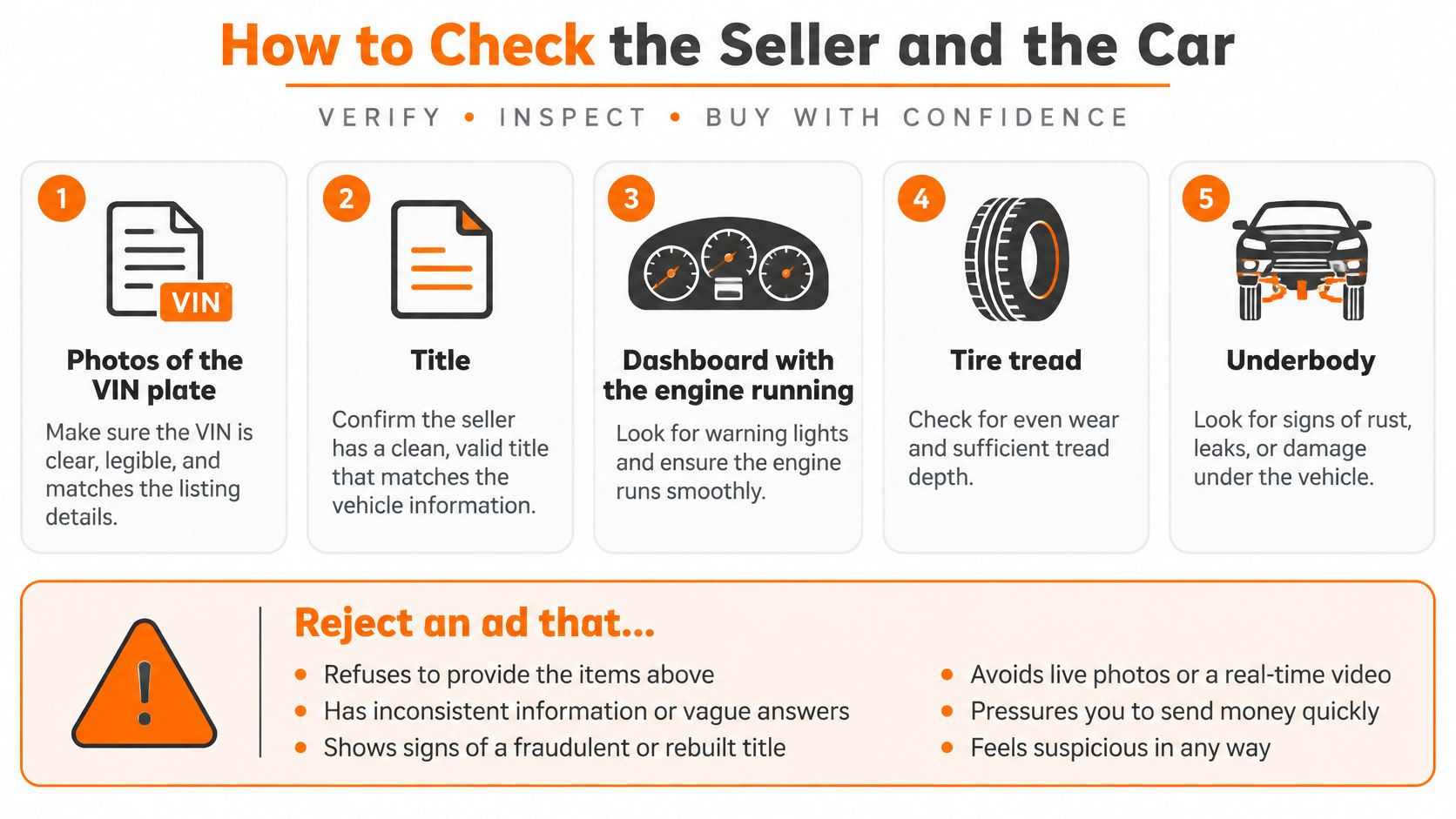
Establish identity before you travel
-
Request useful photos. Ask for the VIN plate, title with unnecessary personal information covered, dashboard with the engine running, tire tread, and underbody. Request close-ups of disclosed damage rather than another flattering exterior shot.
-
Confirm who is selling. Ask whether the seller owns the vehicle or represents a licensed dealership. If someone is selling on another person’s behalf, require a verifiable explanation and the documentation needed for a valid transfer.
-
Agree on a cold start and inspection. Ask the seller not to warm the engine before you arrive. Confirm that an independent mechanic can inspect the car if you remain interested.
Skip a seller who won’t establish vehicle identity or explain their authority to sell. Don’t make a long drive hoping the paperwork will become clearer in person.
Check the documents and mechanical condition on site
Match the VIN on the dashboard, door-jamb label, and title. Compare the seller’s identification with the ownership documents, and verify any lien-release requirements through the relevant registration authority or lender.
Obtain a vehicle-history report and examine title branding, recorded mileage, accident entries, and flood indicators. A report is a screening tool, not a substitute for inspecting the car; missing entries don’t prove that damage never happened.
- Cold start. Watch for difficult starting, persistent smoke, rough running, unusual noises, and warning lights that remain illuminated.
- Tires and underside. Look for uneven wear, leaks, corrosion, damaged mounting points, and signs of poor repairs.
- Road test. Check steering, braking, transmission behavior, operating temperature, and electrical equipment under normal use.
- Independent inspection. Ask the mechanic for a written list separating urgent repairs, upcoming maintenance, and issues that make the purchase unsuitable.
Also check the used car for open recalls using its VIN. Ask how any unresolved issue affects safe use and what remedy is available.
Pay only after the decision is supported
Meet somewhere suitable and public, while allowing access to the agreed mechanic. Don’t wire a holding deposit for an unseen car, and use a traceable payment method with properly completed sale documents.
For resale, record inspection, parts, transport, registration, and selling fees separately. Leave with a supported purchase, a written repair list and revised offer, or a decision to walk away.
Tips When the Cheap Cars Go Fast
You don’t need to assume every dealer lot is empty because your budget search looks thin. At the beginning of October 2025, US dealers held 2.26 million used vehicles, according to Cox Automotive. Your difficulty may be finding suitable cars within a particular combination of price, condition, model, and distance.
That calls for controlled changes, not an impulsive increase in spending. A wider search is useful only if you can still inspect, collect, and maintain what you find.
Change the least expensive constraint first
Start with preferences that don’t determine whether the car can do its job. You might accept another color, a less fashionable body style, or a neighboring search area before accepting an unaffordable loan.
Mileage deserves a more careful adjustment. Loosening a mileage filter can uncover a well-documented car, but don’t remove it just to fill the feed. Review the maintenance schedule and records for the specific model so you understand what work may be approaching.
- Too few nearby matches. Expand into an area you can realistically visit, and include the collection cost.
- Only unsuitable versions. Change engine, transmission, or trim preferences only after checking maintenance implications.
- Consistently unaffordable results. Reconsider the model or buying timetable rather than assuming a seller will accept an unrealistic offer.
- Too much irrelevant inventory. Tighten the filter responsible for the noise instead of disabling every alert.
Change a single criterion, then assess the resulting listings. If you alter model, radius, mileage, and price together, you won’t know which change helped.
Respond quickly without surrendering your checks
A useful first message identifies the car, asks a material question, and offers a realistic viewing time. For example: “Is the title in your name, and can I see it this afternoon if the engine is left cold?” That gives the seller something concrete to answer.
Avoid promising to buy before you’ve verified the vehicle. Speed should shorten the time between noticing a listing and arranging a legitimate inspection, not remove the inspection.
| Ad pattern | Practical response |
|---|---|
| Seller won’t establish ownership | Stop until authority to sell is documented |
| Deposit demanded before a viewing | Decline and pursue another car |
| A supposedly local car suddenly requires shipping | Verify its actual location before proceeding |
| Price far below comparable listings | Investigate title, mileage, and mechanical condition before treating it as a deal |
| Rebuilt-title vehicle promoted as an ordinary commuter bargain | Evaluate it as a different-risk purchase, including repair documentation and insurability |
Speed without pressure: Be ready to view a suitable car, not ready to excuse missing evidence.
A project buyer may accept work that makes no sense for someone who needs dependable transport immediately. Keep your intended use clear when a tempting ad appears, especially if losing another listing has made you impatient.
Lock a Ceiling and Start Watching
The most useful result of searching for cheap car sales near me isn’t a screen full of low prices. It’s a shortlist you can act on without borrowing more than planned or spending the repair reserve before you own the car.
Make the decision rules explicit. You should be able to reject an attractive listing because it fails your budget, just as comfortably as you reject one because the seller can’t explain its history.
Write the watchlist in plain language
Save these lines somewhere you’ll see them while reviewing matches:
- Ownership ceiling. The maximum you can commit to buying, financing, maintaining, insuring, and running the vehicle over your chosen period.
- Maintainable model. A model and version whose service requirements, parts, and repair options fit your circumstances.
- Usable search area. Locations you can reach for a proper viewing and collection without disrupting the budget.
Translate those decisions into filters rather than leaving them as good intentions. Set a purchase-price maximum that leaves room for the other costs, and use a mileage limit that reflects the maintenance risk you’re prepared to assess.
If a car only works financially when nothing breaks, it doesn’t fit. You may need a different model, a different purchase timetable, or a higher sticker price supported by lower expected running costs, not a larger total commitment.
Give each match a clear next action
A household buyer needs affordable transport; a dealer also needs a defensible acquisition cost and room for profit. Both can use saved searches, but the dealer’s offer must leave enough room for preparation, holding, and sale expenses.
There’s no need to chase every ad to participate in a substantial market. Automotive Fleet reported Cox Automotive’s forecast of 20.1 million US used-vehicle retail sales for 2025, a projected 1.2% increase from 2024. That forecast isn’t a promise that your preferred car will appear tomorrow, but it supports patience over treating a questionable listing as your last opportunity.
Both dealers and everyday buyers use Flipify Motors. Keep separate watchlists when your requirements differ, so a project-car opportunity doesn’t become confused with a car you need for daily transport.
Save your criteria today. When a suitable match arrives, review the source ad, resolve the missing information, and propose a specific viewing time. The next step is a controlled search, not automatically a higher ceiling.
Flipify Motors brings matching vehicle listings from multiple marketplaces into saved watchlists, with notifications and comparable-listing context to help you assess nearby options. Visit Flipify Motors to start a free trial, save a maintainable model within your budget and travel area, and review the next match against your ownership ceiling.