
What Is a Fair Price for a Used Car? How to Check It
Find out what is a fair price for a used car by comparing listings, adjusting for mileage and condition, and setting a defensible ceiling.
A fair price for a used car is the median of tightly matched comparable listings, minus the repairs that specific car needs and the costs you’ll pay to put it on the road. Run the numbers on a 2019 sedan with a comparable median near $18,500, $1,200 of immediate repairs and about $900 in taxes, registration and transport, and the ceiling lands near $16,400.
That answer usually surprises people, because the number most buyers go hunting for is a valuation: one figure a website hands them, which they then treat as the price of the car. A valuation is one input. It tells you what a typical example sells for, in average condition, before anyone has looked at the actual vehicle or added up what owning it will cost this week. So why does a car that checks out as fairly priced online so often turn out to be a poor purchase by the time it’s sitting in your driveway?
Because the asking price is a seller’s opening position, not a market fact, and because book values describe a car in the abstract rather than the one in front of you with worn tires and a check-engine light. Understanding what is a fair price for a used car means building the number yourself, in a fixed order, so that every dollar you subtract can be shown to someone else. That order is the rest of this article.
The Short Answer Is a Median Minus Known Costs
Write the formula on one line and keep it there: fair price = comparable median minus inspection repairs minus taxes, fees and transport. Three inputs, one subtraction chain, and a result you can defend line by line if a seller asks how you got there.
The first input carries the most weight. You don’t start from the sticker, the original MSRP, or a flat percentage haircut on either. You start from what a group of near-identical cars is asking right now, and you take the median rather than the average, because one optimistic dealer asking $4,000 over everyone else shouldn’t drag your benchmark upward.
Here’s how the three inputs stack up for a worked example:
| Input | What to Use | Example Figure |
|---|---|---|
| Comparable median | Middle of at least eight listings matched on year, trim, drivetrain and mileage band | $18,500 |
| Inspection repairs | Written mechanic estimate for immediate work | -$1,200 |
| Buyer costs | Taxes, registration, fees and transport | -$900 |
| Fair ceiling | Median less repairs and buyer costs | $16,400 |
The median beats the cheapest listing every time. Asking prices are opening positions, and a car listed far below its cluster is usually cheap for a reason: a rebuilt title, a mileage discrepancy, deferred maintenance, or a seller who knows something the photos don’t show. A car listed far above the cluster is a markup or a stale ad. The middle of the range is where the actual market sits.
Practical rule: Your ceiling is not a negotiating position. It’s the number above which the car stops being a good buy for you, no matter how much you like the color.
The output is a range with a lid on it, not a certificate of value. Two 2019 sedans with identical specification can sit $2,000 apart once condition and history are priced in, which is why the figure you calculate belongs to one specific car and not to the model.
Before you call anyone, write the median down, list every repair the inspection found with its quote, add your buyer costs, subtract both from the median, and circle the result. That circled number is the highest sensible offer, and it isn’t where you start bidding. It’s where you stop.
How to Build a Comparison Set That Holds Up
Everything downstream depends on this step being narrow. A comparison set built from whatever the search page returned on a Tuesday is noise, and noise produces a median that means nothing.
Kelley Blue Book identifies age, mileage, body style, trim level and condition as the core valuation inputs, and it notes that two vehicles of the same age can hold very different values when one has substantially higher usage, such as rideshare mileage (Kelley Blue Book on book values). Those fields aren’t optional filters. They’re the definition of a comparable.
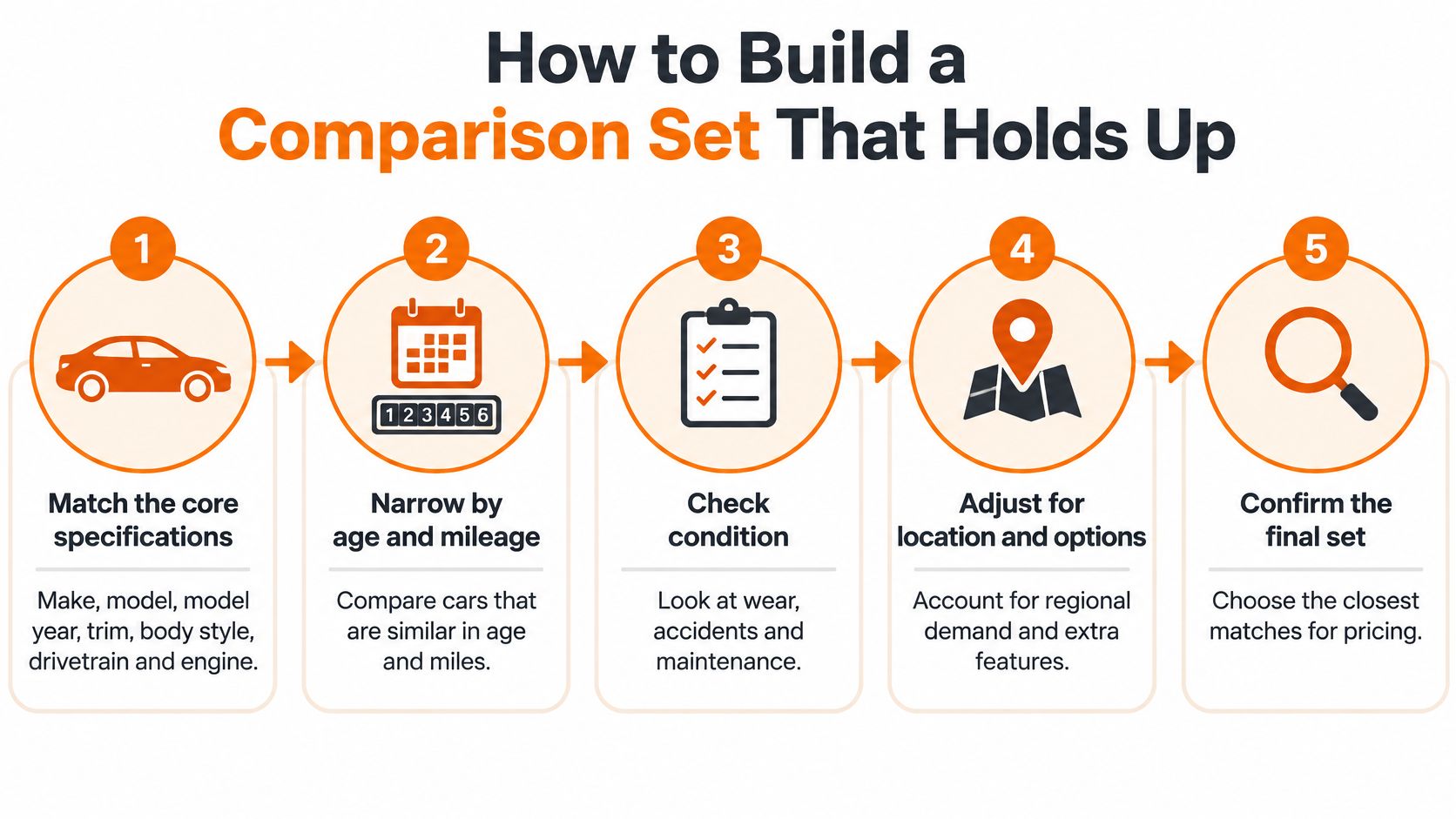
- Match the core specifications. Make, model, model year, trim, body style, drivetrain and engine. A base trim with cloth seats is not a comparable for the loaded version with the same badge, and mixing the two inflates your median by the price of equipment you’re not buying.
- Narrow by age and mileage. Keep the set inside one model year and a tight mileage band around your target. If the car you’re viewing has 62,000 miles, compare against cars between roughly 55,000 and 70,000, not against a 110,000-mile example that happens to share a paint code.
- Set a radius you’d drive. Local supply and regional demand move prices, and a car four hours away carries transport and a wasted Saturday. Flipify Motors lets you limit a search by keyword and location, with the distance set by you, then refine by price, year, mileage and transmission, which keeps the set honest about geography.
- Collect eight to fifteen listings across several marketplaces. One website skews toward dealers, another toward private sellers, and the middle of the range stabilizes once you’ve pulled from both. Fewer than eight and a single seller can set your benchmark.
- Cut the outliers at both ends, then record the middle. Drop the three cheapest and the three dearest, note the median, and note the tight cluster around it. That cluster is your working range.
Why the Middle Beats the Cheapest
A vehicle priced below its comparables is not automatically a bargain. It may carry accident history, title branding, deferred maintenance, missing equipment or inaccurate mileage, and every one of those costs money to resolve. The benchmark is a starting range that has to survive a history check and a physical inspection before it becomes an offer.
Flipify Motors shows comparable listings alongside a match so you can see whether a listing is a real deal, and that’s the right use of the tool: as a second opinion on your own set, not as a replacement for building one. If the car’s asking price sits inside your middle range after adjustments, it’s priced in line with the market. If it sits above, you now know by how much and why.
How Mileage, Age and Trim Move the Price
Mileage is the input buyers mishandle most, and the fix is to judge it against what’s typical for the car’s age rather than against a flat cost per mile. The U.S. Bureau of Labor Statistics handles it exactly that way inside its Used Cars and Trucks Consumer Price Index, which adjusts observed prices for both depreciation and mileage before measuring price changes (BLS used cars and trucks CPI methodology).
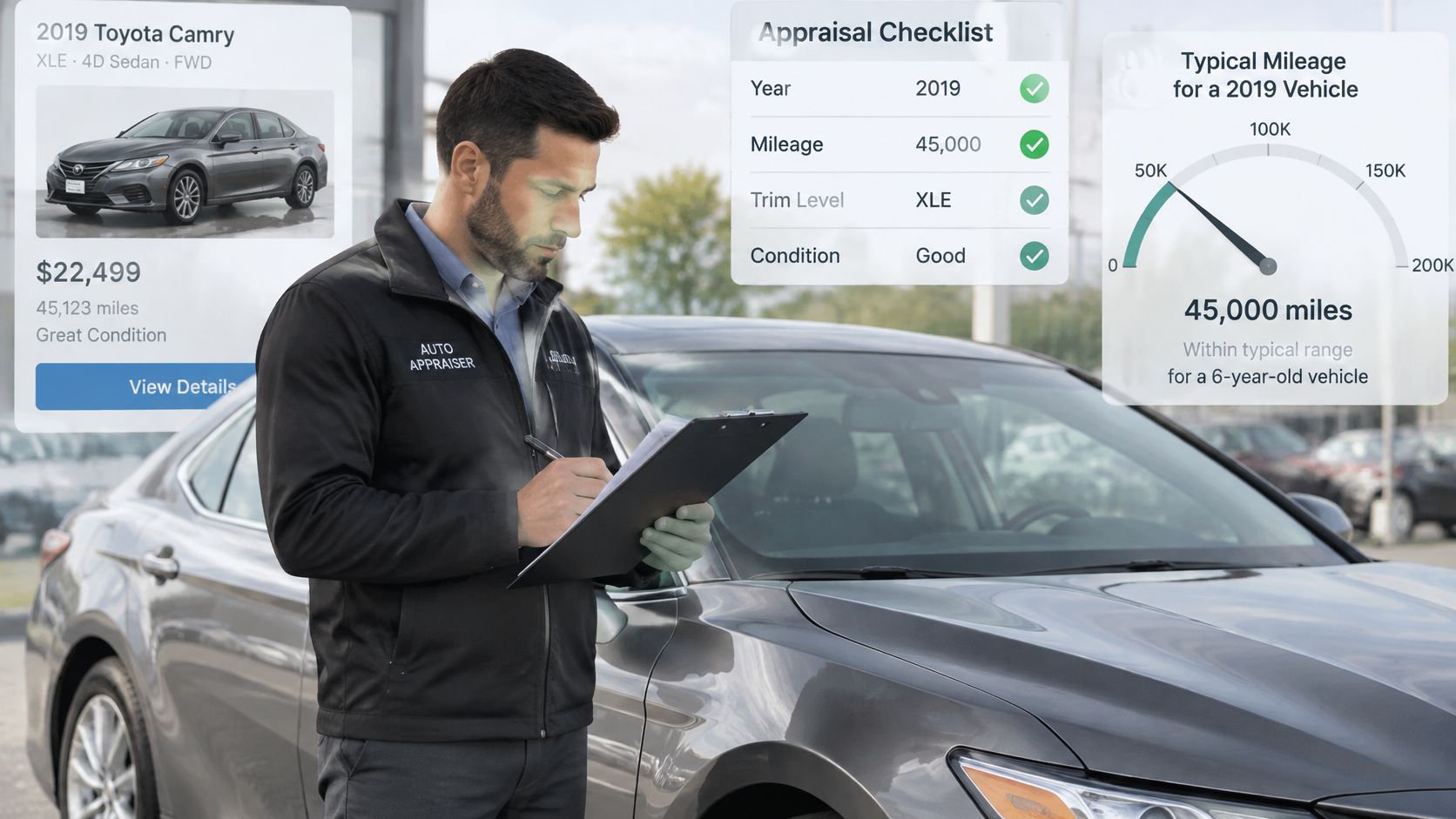
The mileage adjustment in that index reflects the vehicle’s age-specific average mileage rather than one universal assumption, and in January 2024 the BLS moved to an exponential decay curve, so additional miles generally produce a smaller absolute value change at higher mileage levels than at lower ones. That mirrors how appraisers think. Taking a truck from 20,000 to 60,000 miles costs its owner far more value per mile than taking it from 120,000 to 160,000.
The practical consequence is blunt: a 2019 vehicle with 45,000 miles should not be priced against a 2019 vehicle with 120,000 miles without an adjustment, and the adjustment isn’t linear. Compare inside a mileage band, or price the gap to the age-typical average deliberately.
| Factor | How It Moves Value | How to Adjust |
|---|---|---|
| Mileage | Above or below the age-typical average, and each extra mile lowers value by less at high mileage | Compare within a narrow mileage band, or adjust by the gap to the age-typical average |
| Model year | Newer years are usually worth more, but the gap narrows as the car ages | Compare the same model year, or one year apart, then adjust |
| Trim and options | Higher trims and added equipment add value a base model lacks | Match trim exactly, or price the options separately |
| Drivetrain | All-wheel or four-wheel drive can add demand in some regions | Compare only with the same drivetrain |
| Title status | Rebuilt or salvage branding often sells well below clean-title cars | Exclude from the set or adjust heavily, then verify the history |
Trim deserves its own warning. A mid-trim car compared against a top-trim median looks like a bargain, and the same car compared against a base-trim median looks overpriced. Neither reading is real; the trim doesn’t match.
For a closer look at how mileage and condition interact in practice, this short walkthrough covers the appraiser’s view of a single vehicle:
Adjust the median for each difference you find, and write every adjustment down with a one-line reason. A figure you can explain survives a conversation with a seller, a spouse, or a lender. A figure you can’t explain collapses the moment someone asks where it came from.
Turning Condition Problems Into a Price Ceiling
Condition is the adjustment buyers leave as a vague negotiating point, and vagueness always costs the buyer money. The U.S. Federal Trade Commission recommends an independent mechanic’s inspection and a written report identifying necessary repairs and estimated costs, and those repair estimates are what support a price negotiation (FTC guide to buying a used car). A clean-looking car doesn’t get to set its own adjustment.
Turn every finding into a priced line before you talk money:
- Tires and brakes. Use the quoted replacement cost. Four tires and a full brake job are the two most common immediate expenses, and they’re easy to price in advance.
- Warning lights and diagnostic codes. Price the repair once the fault is identified, not the scan fee alone. An oxygen sensor and a transmission fault both light the same lamp.
- Overdue timing-belt or major service. Take the shop’s quote for the job, including the water pump if it’s done at the same time.
- Rust and prior accident repair. Get a body shop estimate rather than guessing from the paint match.
- Missing maintenance records. Hold this as a reserve rather than a fixed deduction, because the cost is uncertain until a specialist looks.
Then work the whole purchase through from median to ceiling:
| Step | Figure Used |
|---|---|
| Comparable median | $18,500, the middle of nine matched listings |
| Less inspection repairs | -$1,200, mechanic quote for brakes and tires |
| Less buyer costs | -$900, taxes, registration and transport |
| Less risk reserve (dealers only) | -$500, buffer for uncertain defects |
A private buyer stops at $16,400. A dealer or flipper carries a further $500 for defects nobody has found yet, which puts the all-in ceiling at $15,900 before any margin is considered. Every figure has a paper trail: the listings, the written inspection, the registry or transport quote.
Two errors wreck this arithmetic. The first is subtracting the advertised discount from the asking price instead of subtracting real costs from the median, which lets a marked-up listing flatter itself into looking fair. The second is treating a low listing as a bargain when the repair quote consumes the entire gap. If the car reconditioning costs for flippers run past the discount, the cheap car is the expensive one.
For resellers: A purchase is financially fair only when expected resale proceeds, after reconditioning, fees and a risk allowance, still leave your required margin. A low buy price with hidden repairs is a loss wearing a discount.
The arithmetic scales down as well as up. On a $6,000 car, a $900 set of tires and brakes is 15% of the price, so condition findings carry proportionally more weight than they do on a $30,000 truck.
Location, Seller Type and Buyer Use
Geography changes both the comparison set and the all-in cost. Set your search radius to the distance you’ll travel, because a car six hours away needs transport priced into the ceiling, and regional demand can swing the same model by four figures between neighboring states.
Seller type changes what the ceiling has to cover. A dealer price often bundles documentation and reconditioning, so ask what’s included before comparing it to a private ad. A private sale usually leaves taxes, registration and transport sitting on top of the asking price.
Buyer use decides which market you’re shopping in. At the start of 2026 the average used-vehicle listing price was about $26,043, while vehicles priced below $15,000 carried only 38 days of supply, 11 days less than the overall market (Cox Automotive used-vehicle inventory data). A buyer hunting an inexpensive commuter is competing in the thinnest part of the market, so paying close to the median for a well-maintained example is reasonable rather than weak.
For resale-minded buyers, direction matters as much as level. The Manheim Used Vehicle Value Index rose 2.4% year over year in January 2026, but compact cars showed weaker price growth, non-electric vehicles outperformed electric vehicles, and EV wholesale values moved only 0.4% from December against 2.2% for non-EVs (Cox Automotive on the January 2026 Manheim index). If you’re buying an EV to resell in ninety days, ask for a battery health report, check remaining warranty, and confirm local demand before paying a full median.
Why Supply and Timing Change a Fair Price
A benchmark you built last month can mislead you this month, because supply moves and prices follow it. Federal Reserve research found that pandemic-era fiscal stimulus explained about 70% of the inventory decline through the end of 2021 and added approximately 1.3 percentage points to vehicle price increases in subsequent years, with the drop in inventory identified as a major source of the price pressure (Federal Reserve FEDS paper on vehicle prices).
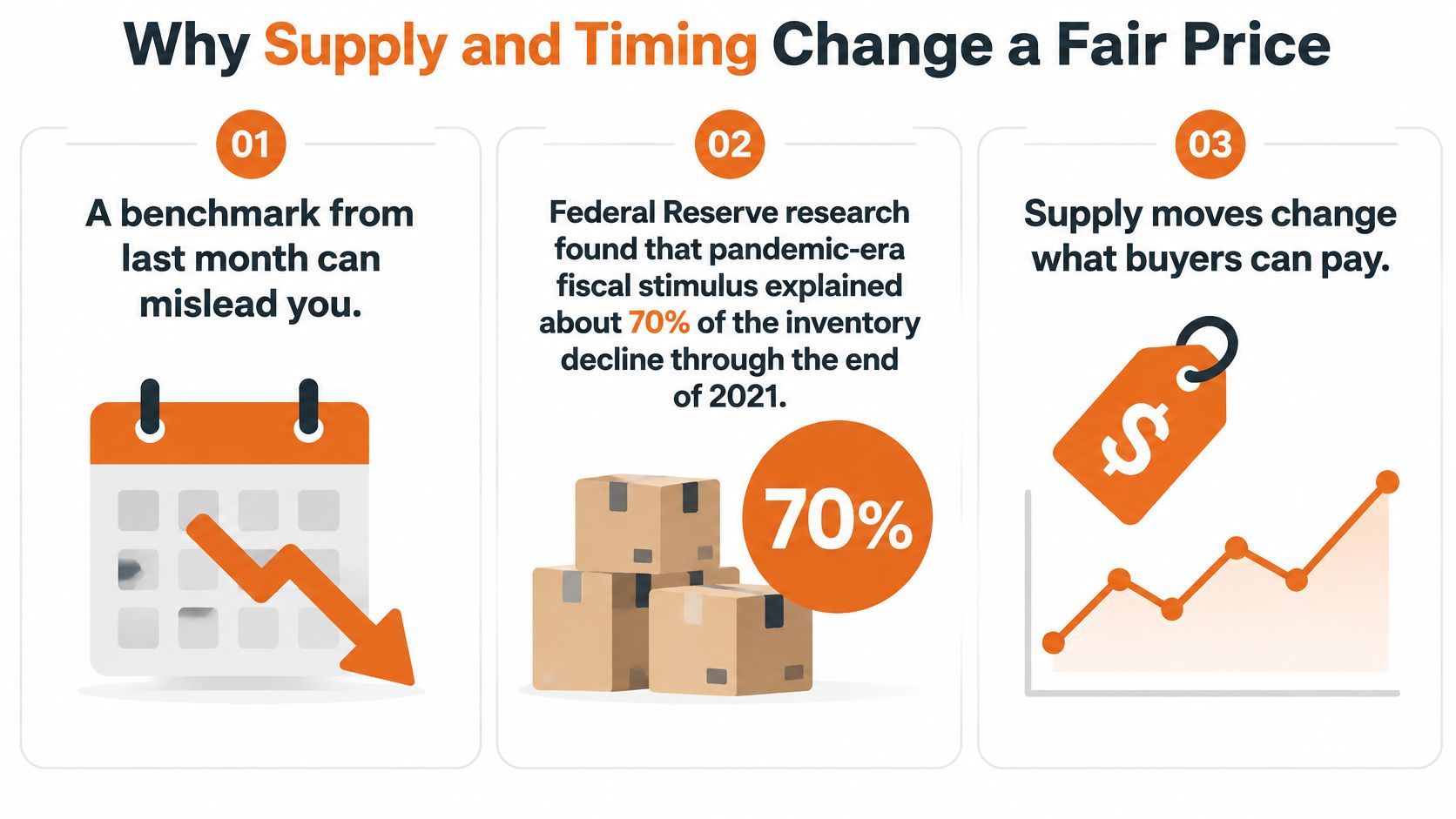
That episode sets the rule. A fair price isn’t welded to a historical book value or a simple age-based depreciation schedule. It has to be checked against current supply, buyer demand and the availability of close substitutes. When comparable inventory is scarce, sellers can command a premium even on an older car. When listings pile up and sit, you can reasonably negotiate below the median.
The Bureau of Labor Statistics used-car index shows how far the whole market travels within a single year, reaching 188.960 in August 2025 against a 1982 to 1984 base of 100, then easing to 183.052 in December 2025. Neither figure is the price of any individual car, and that’s the point: market-wide movement dwarfs the small adjustments most buyers argue over.
Watch the supply of your specific target rather than the market as a whole. If matching listings are appearing in greater numbers and sitting unsold, your median is likely to soften within weeks and patience pays. If they’re thinning out, expect firmer asks and be ready to move on a good example.
Our used-car price tracker shows typical asking prices for used cars, built from real listings across the marketplaces we watch, which gives you a fast sanity check before you invest an hour building a full comparison set. For the Honda Civic, the typical asking price is $4,699, with most listings ranging from $2,800 to $8,950 across 13,631 listings, which is the kind of spread that makes a single book value look useless.
A median is a snapshot, not a verdict. Rebuild it the week you plan to buy.
Confirm the Ceiling Before You Make an Offer
Decision time, and it’s short. Open inside your defensible range and walk away if the seller won’t move into it.
- Re-check the median against live listings. Prices move week to week, so confirm your cluster still holds before you name a number.
- Offer a range, starting near the lower end. A range signals you’ve done the work; a single lowball invites a counter you didn’t plan for.
- Send the inspection list with each item priced. Sellers argue with opinions and negotiate with itemized quotes.
- Fix your walk-away figure before the conversation. Write it down and don’t raise it mid-call, when the emotional pull is strongest.
- Give resale sourcing about a week of watching. New comparables tell you whether the car is underpriced or just falling faster than its peers.
If negotiation isn’t your strength, negotiating with a private seller covers the language that keeps the conversation on the numbers rather than on feelings.
Close the loop by putting the offer, the ceiling and the reason for each adjustment on one page. A documented decision is easier to hold when a seller pushes, and easier to review later when you want to know whether your method works.
Flipify Motors watches six marketplaces and alerts you when a matching vehicle appears, so the comparable set you built stays current instead of stale by the weekend. You can save searches by make, model, year, price, mileage and distance, see comparable listings beside each match, and track a flip from purchase through sale. Start the free trial on the website and let the right listings come to you at Flipify Motors.